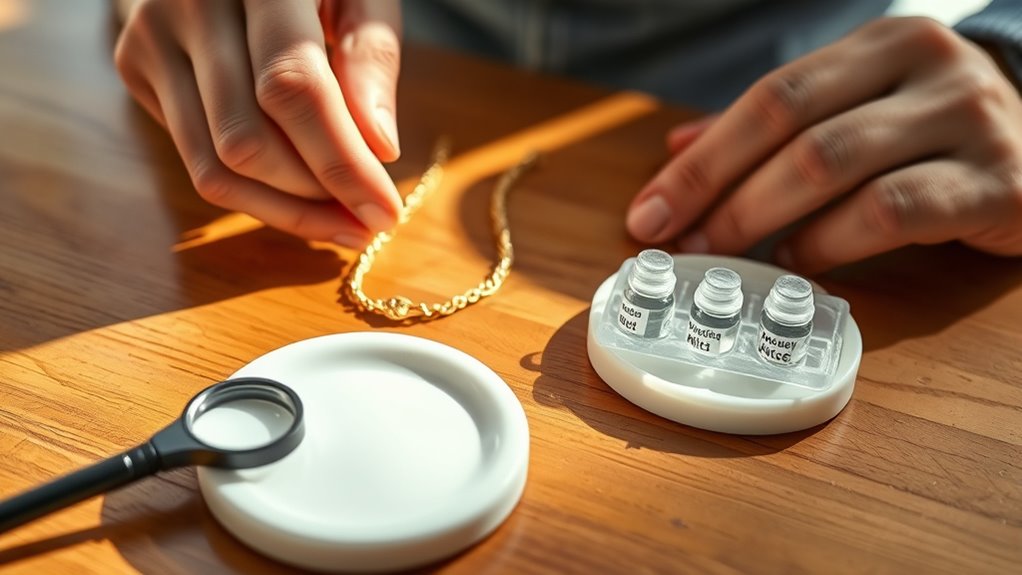
How to Tell If My Jewelry Is Real Gold Step by Step
Start by checking for clear hallmarks like 10K, 14K, or 750 inside your jewelry.
Next, test if it’s magnetic—real gold isn’t attracted to magnets.
Clean your skin and try the skin reaction test; real gold won’t cause discoloration.
Weigh your piece and compare its density to gold’s standard 19.3 g/mL.
You can also dip it in vinegar—no reaction means it’s likely genuine.
Keep exploring these steps to confidently assess your gold’s authenticity.
Inspect Jewelry for Hallmarks and Purity Stamps

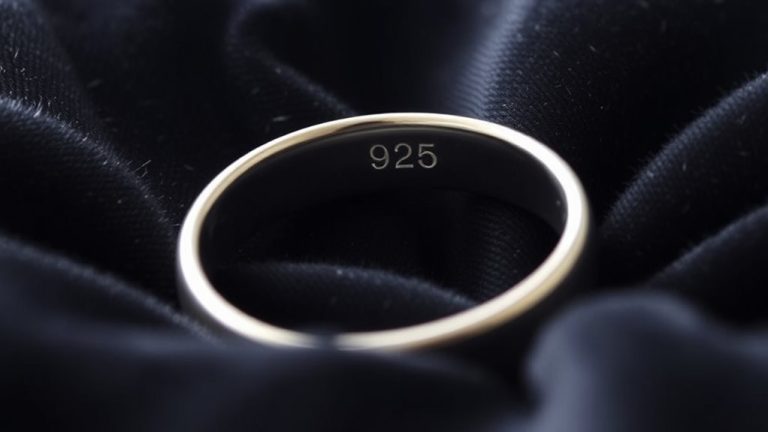
When you inspect jewelry for hallmarks and purity stamps, start by looking for official marks like 10K, 14K, 18K, or 24K that indicate the gold content.
These karats tell you the exact gold purity. Also, check for numerical stamps such as 585, 750, or 999, which correspond to specific gold content levels.
During your jewelry inspection, focus on engravings and manufacturer marks often found inside rings, clasps, or hidden areas.
Authenticity marks should be clear and consistent; poorly stamped symbols or smudged engravings can signal counterfeit items.
Watch out for misleading marks like GP, GF, or HGP, indicating gold plating rather than solid gold.
Careful hallmark and purity stamp examination is a vital step in counterfeit detection and confirming your jewelry’s genuine gold content.
Perform the Skin Reaction and Magnet Tests

Although hallmark inspection is essential, you can further verify your jewelry’s authenticity by performing simple skin reaction and magnet tests.
Start by cleaning your skin and jewelry to avoid false results from lotions or makeup.
Genuine gold is non-magnetic and won’t cause skin discoloration or irritation.
On the other hand, fake gold often contains base metals that attract magnets and leave green marks on your skin.
| Test Type | Genuine Gold Result | Fake Gold Result |
|---|---|---|
| Skin Reaction | No skin discoloration or irritation | Green marks or skin irritation |
| Magnet Test | Non-magnetic (no attraction) | Attracted to magnet (magnetic) |
| Jewelry Testing | Clean, non-reactive surface | Possible discoloration, reacts |
Use these tests to spot fake gold and ensure your jewelry is truly genuine gold.
Conduct Weight, Size, and Density Comparisons

After ruling out magnetic attraction and skin reactions, you can further verify your jewelry’s authenticity by comparing its weight, size, and density.
Use a precise scale and ruler to measure your piece’s weight and size.
Then, calculate density by dividing weight by volume.
Genuine gold has a high density of about 19.3 grams per milliliter, making it noticeably heavier than most fake items.
For an accurate comparison, weigh a known gold piece of similar size.
If your jewelry feels lighter, it likely contains less gold or is gold-plated with base metals like copper or aluminum.
This measurement-based verification helps you spot fakes with greater accuracy.
Use Household Items for Vinegar and Float Testing
Since genuine gold has unique physical properties, you can use common household items like vinegar and water to test your jewelry’s authenticity.
Start with the vinegar test: place a few drops of white vinegar on the jewelry’s surface and watch for any color change or surface reaction after 15 minutes.
Real gold won’t react or discolor.
Next, try the water sink test by submerging the piece in water; genuine gold’s high gold density makes it sink quickly.
For more household testing, drag your jewelry across an unglazed ceramic tile—it should leave a gold-colored streak, unlike fake metals that leave dark marks.
Also, remember gold is non-magnetic, so a magnet won’t attract it.
These simple tests help confirm your jewelry’s authenticity without specialized tools.
Seek Professional Evaluation and Advanced Testing Methods
When you want a definitive answer about your gold jewelry, turning to a professional is the best step.
Certified jewelry stores and gemologists use advanced testing methods like X-ray fluorescence (XRF) and electronic gold testers to assess gold purity accurately.
Professional evaluation often includes hallmark verification and acid tests for thorough authentication.
These non-destructive testing options ensure your piece remains intact while confirming its value.
| Testing Method | Description |
|---|---|
| X-ray Fluorescence (XRF) | Determines exact metal composition |
| Acid Tests | Uses nitric acid to verify gold purity |
| Electronic Gold Testers | Measures electrical conductivity for karat |
| Hallmark Verification | Confirms authenticity via stamped marks |
Trust experts for reliable results and peace of mind.
Frequently Asked Questions
How to Tell if Jewelry Is Real Gold at Home?
You can check if your jewelry’s real gold by looking for stamps like 14K.
Doing a magnet test is also helpful.
Observe if it sinks in water, as real gold is dense.
Trying a vinegar drop for discoloration can indicate authenticity.
Lastly, inspect for wear or fading signs; real gold should maintain its luster.
What Are the Two Letters for Gold?
You’ll spot two letters for gold: “K” and “RT.”
When you see 14K or 750 RT, they both tell you the gold’s purity—like secret codes revealing your jewelry’s true value in plain sight.
How to Tell if Gold Is Real With a Lighter?
You hold the lighter flame briefly to your jewelry;
real gold won’t catch fire or change color, just glowing brightly.
If it darkens, smokes, or melts quickly,
it’s likely fake or gold-plated.
Be cautious!
Conclusion
You might feel unsure holding your jewelry, torn between doubt and hope.
One moment, those tiny hallmarks whisper authenticity; the next, a magnet’s pull sows suspicion.
Simple home tests contrast with professional evaluations, each revealing different truths.
This dance between certainty and question reminds you that real gold isn’t just about weight or shine—it’s about trust, value, and the story you choose to believe.
Don’t rush—let your jewelry tell its true tale.
—
To determine if your jewelry is real gold, you can start by looking for hallmarks or stamps that indicate its purity.
Next, you can perform some simple tests at home, like the magnet test, or take it to a professional for a more thorough evaluation.
Remember, real gold stands out with its unique properties, and understanding these can help you feel more confident in your jewelry’s authenticity.
Trust the process, and let your jewelry reveal its true worth.