7 Tips to Identify Fake Jewelry
To spot fake jewelry effectively, you need to arm yourself with knowledge about the brand’s unique design traits and signature marks. This can be a game-changer in identifying authentic pieces.
Start by checking hallmarks and logos carefully for clear, correct details and proper stamps.
Next, examine the craftsmanship of the jewelry.
Look for smooth finishes, secure gemstone settings, and solid weight. These factors can indicate the quality of the piece.
You can also test metals for non-magnetic properties and assess stones for natural flaws.
Always buy from reputable sellers who provide authentic certification to ensure you’re getting what you pay for.
These tips help you avoid fakes and protect your investment.
Keep going to discover more ways to guarantee authenticity!
Research the Brand and Designer Characteristics

How can you tell if a piece of jewelry is truly authentic?
Start by researching the brand and designer characteristics.
Begin by exploring the brand’s unique traits and designer hallmarks to distinguish authenticity.
Study the brand’s official history and familiarize yourself with signature motifs and design elements unique to authentic styles.
Pay close attention to hallmarks, logo placement, and engraving techniques—these details reveal brand consistency and help in recognizing signatures.
Knowing the specific metals, gemstones, and finishing standards the brand uses also aids in spotting fakes.
For example, Cartier’s panther motif or Tiffany’s signature blue box are design elements that distinguish genuine items.
By understanding these aspects, you can quickly identify whether a piece aligns with the brand’s authentic styles or if something feels off.
This knowledge will help you avoid counterfeit jewelry.
Verify Hallmarks and Logo Authenticity

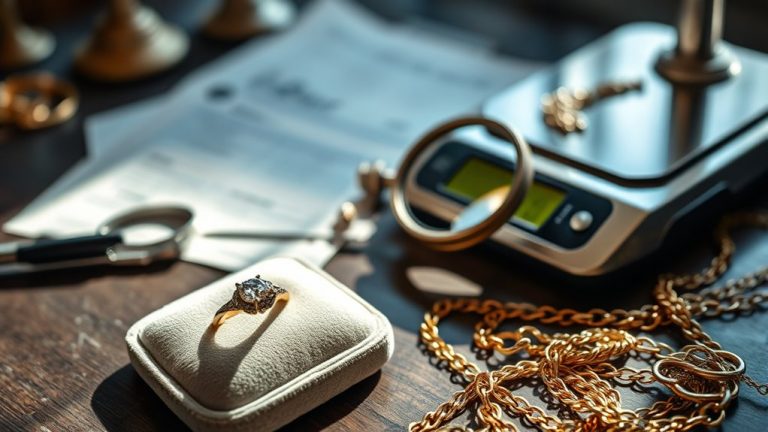
Start by closely inspecting the hallmark with a magnifying glass.
Make sure it’s clear, correctly spelled, and matches official standards.
Check that the logo’s font, size, and placement align with the brand’s authentic design.
These details help you spot inconsistencies that often reveal fake jewelry.
Hallmark Inspection Techniques
Although hallmarks can be small, they reveal crucial information about jewelry authenticity.
When you perform hallmark inspection, focus on metal purity marks and brand stamps that conform to official standards.
Use a magnifying glass to check engraving quality and stamp placement carefully.
Here’s what to look for:
- Sharp, clear engravings without misspellings or irregularities.
- Accurate metal purity marks like “925” or “750,” properly stamped, not faint.
- Correct stamp placement aligning with official brand stamps.
- Additional marks such as country of origin or manufacturer’s symbols matching genuine items.
Mark verification helps you spot fake jewelry, since counterfeit pieces often have inconsistent logos or poorly placed stamps.
Paying attention to these details ensures you identify authentic pieces confidently.
Logo Consistency Checks
When verifying jewelry authenticity, you should closely compare the logo or hallmark with official brand references from their website or authorized retailers.
Check the logo’s design details carefully—authentic brands maintain consistent fonts, sizes, and signature motifs.
Use a magnifying glass to examine the engraving quality; genuine logos are sharply etched with no uneven lines or blurring.
Pay attention to spelling, spacing, and alignment, as any irregularities often signal counterfeit pieces.
Also, verify the placement of hallmarks, which reputable brands position discreetly according to their hallmarking guidelines.
Assess Craftsmanship Quality

Three key signs help you assess craftsmanship quality in jewelry: symmetry, smooth finishes, and secure gemstone settings.
Key indicators of jewelry quality are symmetry, smooth finishes, and secure gemstone settings.
When you inspect a piece, look closely for these indicators to spot genuine quality craftsmanship.
- Symmetry: Elements are evenly aligned with consistent proportions.
- Finish: Surfaces are smooth and lustrous, free of rough edges, scratches, or visible seams.
- Setting: Gemstones sit securely with uniform prongs; no glue or looseness.
- Detailing: Clasps, hinges, and joints operate smoothly without visible soldering flaws or irregular shapes.
Avoid pieces showing craftsmanship flaws like uneven surfaces, inconsistent detailing, or sloppy soldering.
Paying attention to these details guarantees you can confidently distinguish authentic jewelry from fakes.
Evaluate Weight and Material Composition
How can you tell if a piece of jewelry is genuine just by holding it?
Start by evaluating its weight and material composition.
Genuine gold and silver pieces usually feel heavier because authentic precious metals have a denser composition than counterfeit alternatives.
If the jewelry feels hollow or unusually light for its size, it’s likely fake.
You can also test if the metals are non-magnetic—authentic gold and silver won’t react to a magnet, while some counterfeit materials might.
Additionally, observe the jewelry’s surface for signs of tarnishing or discoloration; genuine metals resist these effects, whereas fake pieces often show uneven fading over time.
Inspect Gemstone Quality and Settings
After checking the weight and material of a piece, turn your attention to the gemstones and their settings.
Look closely at the gemstone quality—real stones often have internal flaws visible under magnification, unlike flawless fakes.
Real gemstones often reveal natural internal flaws under magnification, setting them apart from flawless imitations.
Check the optical properties; genuine gems display fire and dispersion that counterfeits rarely mimic.
Examine the color for any uneven coloring or dye stains.
Finally, inspect the settings: authentic jewelry features secure, evenly spaced prongs and smooth metalwork.
On the flip side, fake pieces might have loose, poorly aligned prongs or glued settings with rough edges.
Pay attention to these details:
- Natural inclusions inside gemstones
- Vibrant, evenly distributed color
- Secure prongs holding stones firmly
- Precise metalwork without glue residue
This careful inspection helps you spot fake jewelry at a glance.
Conduct Basic Authenticity Tests
While visual inspection reveals a lot, you can also conduct simple authenticity tests at home to verify your jewelry’s genuineness.
Start with the magnet test—genuine gold, silver, and platinum aren’t magnetic, so if your piece sticks, it’s likely fake.
Next, try the ceramic streak test by rubbing the jewelry on unglazed porcelain; real gold leaves a gold-colored streak, while fakes leave a dark mark.
Use a gold testing kit for acid testing: place a drop of acid on a discreet spot—authentic gold won’t react, but fakes will change color.
You can also do a weight comparison, as authentic pieces have higher metal density and feel heavier.
Don’t forget to check hallmarks or stamps for authenticity verification before drawing conclusions.
Consider Seller Reputation and Documentation
Before buying, check the seller’s credentials and verify their reputation through reviews and business history.
Always ask for official authenticity certificates to confirm the jewelry’s genuineness.
If a seller hesitates to provide proper documentation, consider it a red flag.
Seller Credentials Verification
How can you be sure the jewelry you’re eyeing is genuine?
Start by verifying the seller credentials carefully. A reputable seller will offer verifiable credentials that confirm their legitimacy and the authenticity of their products.
Here’s how to do it:
- Check online reviews and ratings to gauge the seller’s reputation.
- Confirm affiliation with recognized trade associations like the Jewelers of America or GIA.
- Request a certificate of authenticity and any grading reports related to the jewelry.
- Review the seller’s return policy and ensure they provide clear contact information.
Request Authenticity Certificates
Why should you always request an authenticity certificate when buying high-value jewelry?
Because it serves as essential quality proof, assuring you the piece is genuine.
Always ask for a certificate issued by a reputable lab that includes detailed certification details such as the issuer’s credentials, date of issue, and results of gemstone testing.
Don’t just take the seller’s word—verify certification by cross-checking the certificate number or QR code with the issuing lab’s official database.
Be cautious of certificates that seem generic or poorly formatted, as they might indicate fake jewelry.
Also, consider the seller’s reputation; reputable dealers typically provide authentic certificates to back their pieces.
This gives you confidence in your purchase and protects you from counterfeit risks.
Frequently Asked Questions
Does Fake Gold Float or Sink?
Fake gold usually floats or hovers in water because it’s less dense than real gold.
You’ll notice real gold sinks quickly.
Can a Jeweler Quickly Spot a Fake Diamond?
You can spot a fake diamond as quickly as a jeweler spots a smudge on glass.
They’ll use tests like thermal conductivity or a diamond tester.
Their trained eye catches flaws fake stones can’t hide easily.
How Do I Know if My Jewellery Is Real?
You can tell if your jewelry is real by checking for hallmarks, testing with a magnet, and feeling its weight.
Inspecting the craftsmanship is also important.
If you’re still unsure, you can use an acid test or consult a jeweler for a professional evaluation.
How to Tell if Jewelry Is Metal or Plastic?
Imagine holding a rock versus a feather; you’ll feel the weight difference.
You can tell jewelry’s metal if it feels heavy, cool, and has hallmarks.
Plastic, on the other hand, feels light, warm, and lacks stamps or a magnetic reaction.
Conclusion
So, unless you’re aiming to bedazzle your cat or impress your plants, don’t just trust that shiny thing in the bargain bin.
Do your homework, check those hallmarks like a detective on a juicy case, and don’t be fooled by sparkle alone.
Remember, real jewelry won’t quit on you after one wear—or make you question your life choices.
Stay sharp, or you’ll end up with more costume drama than glam!
—
In conclusion, identifying fake jewelry is crucial to ensure you’re getting quality pieces that last.
Take the time to research and inspect items closely, paying attention to hallmarks and overall craftsmanship.
Don’t let a shiny facade lead you astray; real jewelry should bring joy and durability, not regret.
Stay vigilant and informed, so you can enjoy authentic elegance without falling for impostors!