How Can You Tell If Jewelry Is Real Step by Step
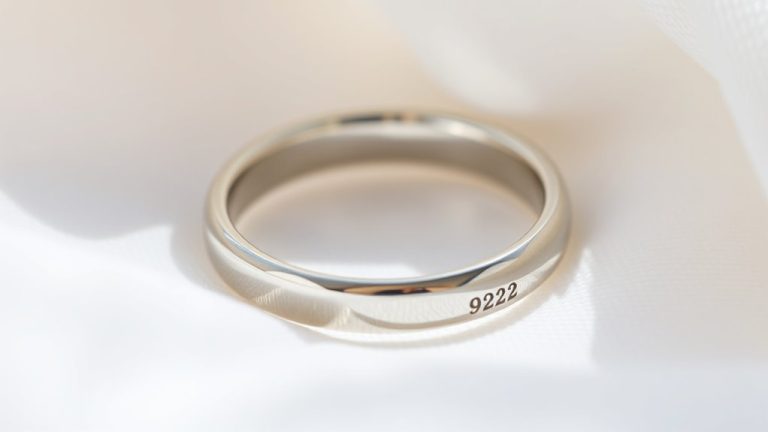
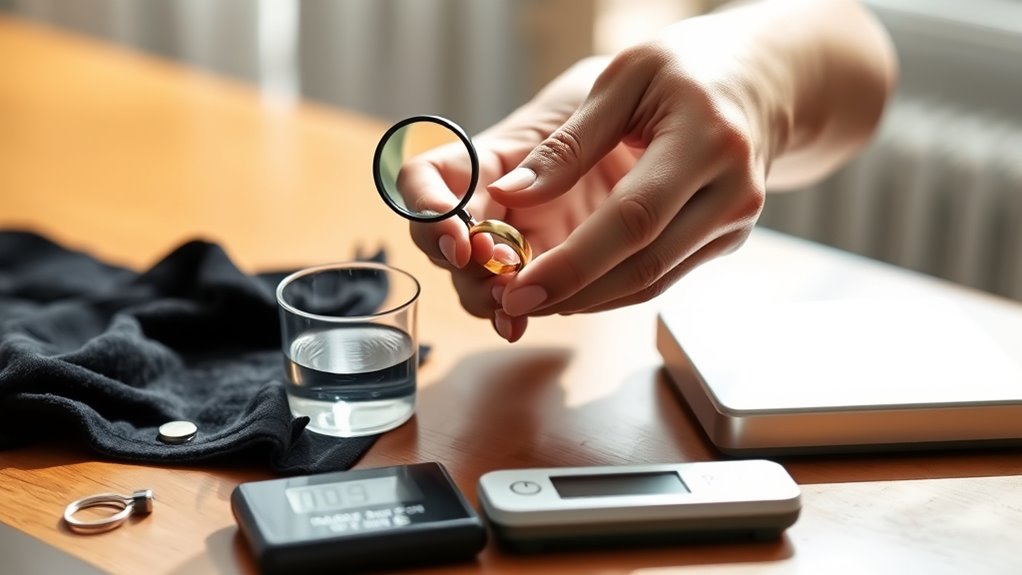
You can tell if jewelry is real by first looking for clear hallmarks like 14K or 925 under magnification. These markings indicate the metal’s purity.
Feel its weight—real gold or silver is heavy and solid. If it feels light, it might be a fake.
Next, try the magnet test; genuine gold won’t stick. A simple magnet can help you determine if your jewelry is made of real metal.
Dab vinegar on a hidden spot; real metals won’t react. If there’s fizzing or discoloration, it’s likely not genuine.
You can also measure density by water displacement or perform a scratch test with acid.
Watch for skin discoloration after wearing; this can indicate cheaper metals are used.
For certainty, a professional jeweler can confirm authenticity.
Ready to explore these steps more closely?
Inspect Jewelry for Hallmarks and Metal Stamps
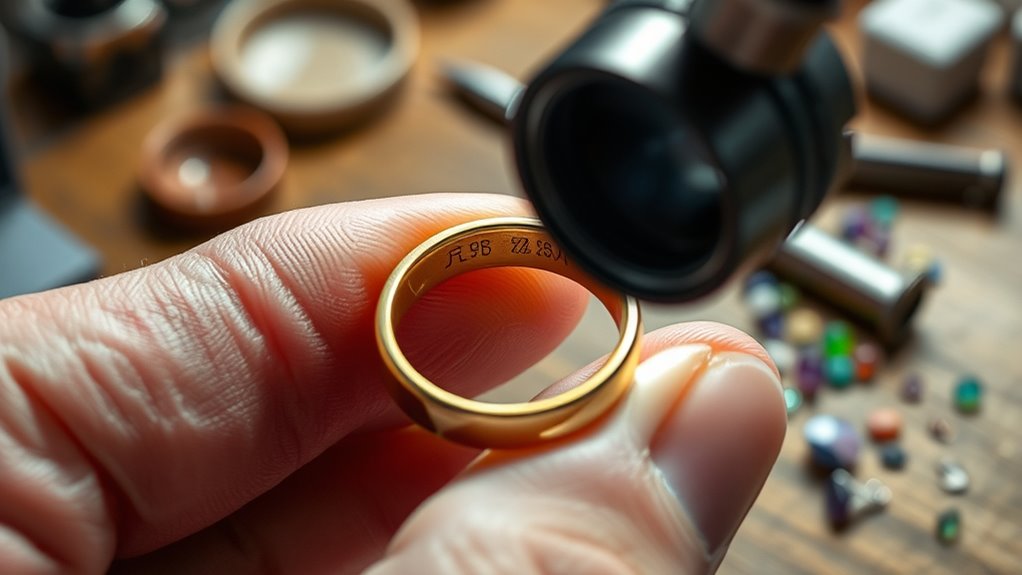
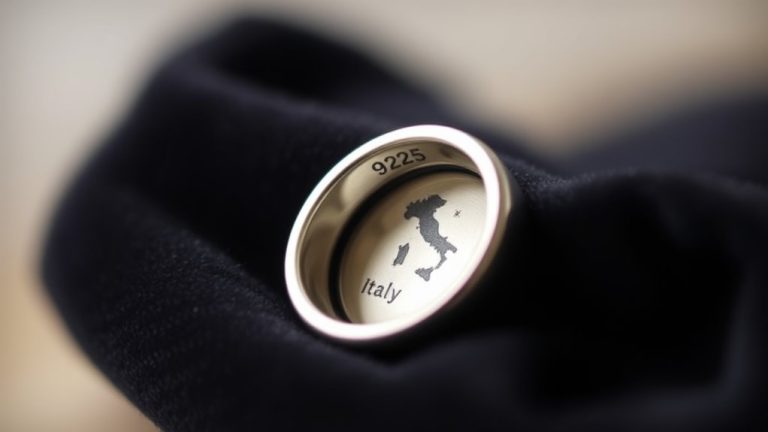
When you inspect jewelry, check for tiny hallmarks or metal stamps in less visible spots like inside rings, clasps, or the back of pendants.
These markings reveal the metal type and purity, such as 10K, 14K, or 18K for gold, or 925 and Sterling for silver.
Platinum often shows marks like PT950 or PLAT.
These hallmarks help confirm authenticity, but their absence doesn’t automatically mean the piece is fake—you’ll need further testing.
Watch out for poorly stamped or blurry marks under magnification, as counterfeit items often display fake hallmarks.
Evaluate the Weight and Feel of the Jewelry
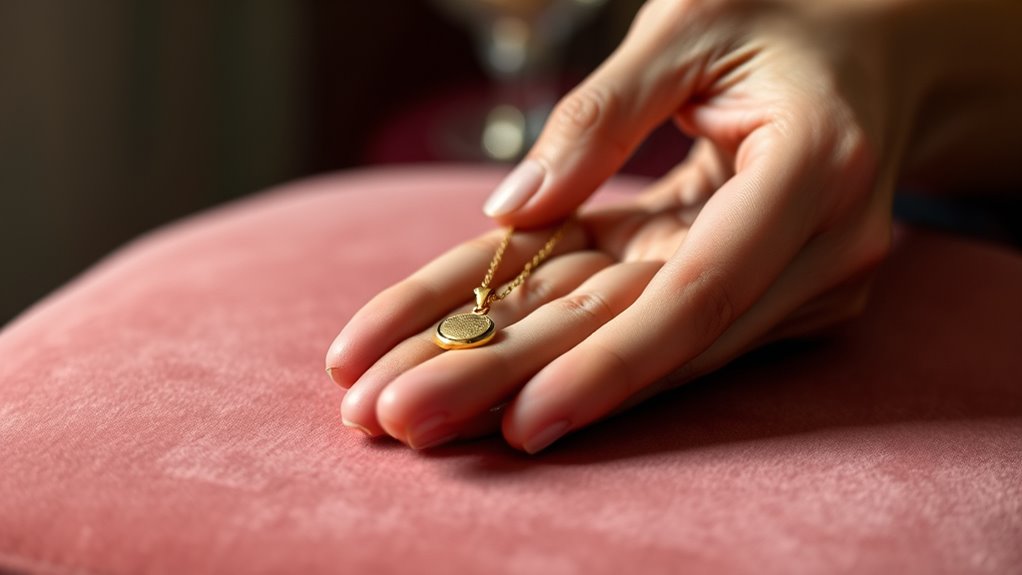
You’ll want to hold the jewelry and feel its weight in your hand—real gold pieces usually feel heavier and more solid than fakes.
Compare how it balances and its density against similar items you know are genuine.
If it feels unusually light or flimsy, it might be hollow or made from cheaper metals.
Assess Density and Heaviness
Although appearance matters, the weight and density of jewelry often reveal its authenticity more reliably.
You can start by weighing the piece on a precise scale. Solid gold, for example, has a high density around 19.3 g/mL, giving it notable heaviness for its size.
If the jewelry feels unusually light, it might be hollow or plated.
The ceramic scratch test also helps: genuine gold leaves a gold-colored streak on unglazed ceramic, indicating higher density.
| Test Method | What to Expect |
|---|---|
| Weight Measurement | Matches solid gold density (heavy) |
| Visual Size Comparison | Feels substantial, not flimsy |
| Ceramic Scratch Test | Gold-colored streak, confirming density |
| Touch and Feel | Solid, heavy, dense sensation |
| Lightweight Jewelry | Possibly fake or plated material |
Use these checks to assess your jewelry’s real density and heaviness.
Compare Craftsmanship and Weight
Since genuine gold jewelry carries more weight and density, you can often tell its authenticity by how it feels in your hand.
When you hold a piece, notice if it feels solid and substantial—this weight is a hallmark of genuine gold.
Compare the craftsmanship closely: authentic jewelry features smooth edges, secure stone settings, and a uniform finish.
Poor craftsmanship, like jagged edges or loose stones, often signals fake or plated pieces.
You can also weigh the jewelry and compare its weight to standard benchmarks for similar items.
By evaluating both the craftsmanship and weight, you gain clearer insight into the jewelry’s authenticity.
Trusting your sense of touch and attention to detail helps you distinguish genuine gold jewelry from imitations effectively.
Perform the Magnet Test for Metal Authenticity
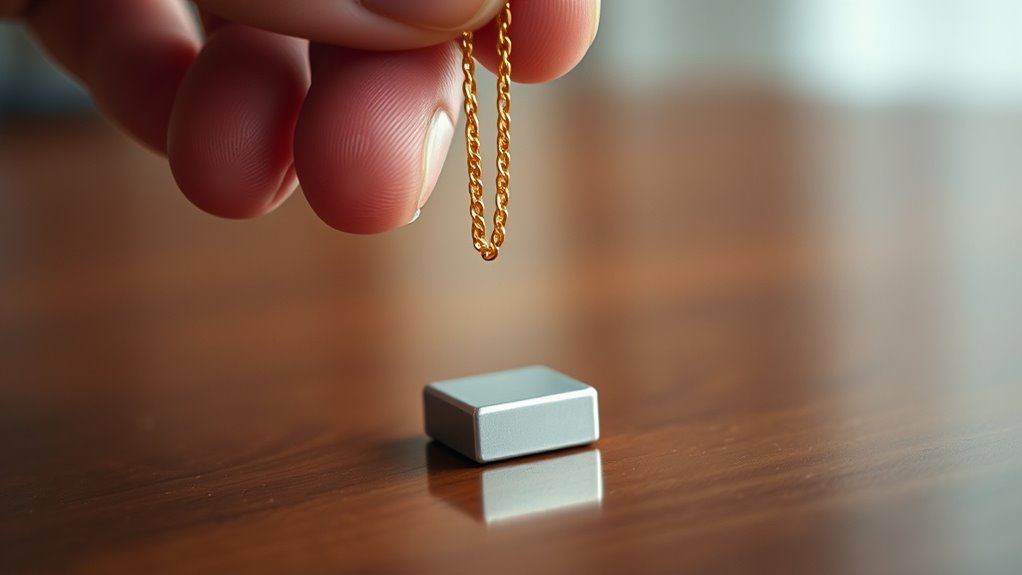
When you hold a strong magnet near your jewelry, it can reveal whether the piece contains real precious metals like gold, silver, or platinum, which are generally non-magnetic.
Use a powerful magnet, like a neodymium one, to perform the magnet test.
Perform the magnet test using a strong neodymium magnet for accurate results.
If your jewelry is attracted to the magnet, it likely contains ferromagnetic metals such as iron or steel, indicating it might be fake gold or another imitation.
However, remember that not all non-magnetic pieces are authentic precious metals, as some costume jewelry can also be non-magnetic.
Also, platinum is only weakly magnetic, so a lack of magnetism alone doesn’t guarantee authenticity.
For the best results, combine the magnet test with other methods to confirm your jewelry’s authenticity.
Conduct the Vinegar Test to Check for Reactions
You can complement the magnet test by conducting the vinegar test to check how your jewelry reacts to a mild acid.
Place a small drop of white vinegar on an inconspicuous area of the piece and watch closely.
If the metal is genuine gold, it won’t react or discolor, showing its high purity and durability.
However, if the jewelry is fake or plated, the vinegar test may cause it to darken, discolor, or develop a greenish tint within a few minutes.
To get the best results, pick a less visible spot for this test and compare it with an unaffected area.
Keep in mind, the vinegar test is a quick preliminary check and should be combined with other methods for a reliable assessment.
Use Water Displacement to Measure Density
First, weigh your jewelry carefully using a precise scale to get an accurate measurement in grams.
Next, record the initial water level in a graduated cylinder before submerging the piece completely.
Finally, calculate the density by dividing the jewelry’s weight by the volume of water it displaces.
Then, compare that number to standard gold density ranges.
Measure Weight Accurately
Accurately measuring your jewelry’s weight is essential to determining its authenticity. Using water displacement to find its density can help you do just that.
First, use a precise scale to measure weight in grams.
Next, you’ll submerge the jewelry in water to find the volume displaced.
Dividing the weight by this volume gives you the jewelry density.
Comparing this value to the standard gold density (19.3 g/mL) helps verify authenticity.
| Step | Action |
|---|---|
| 1. Measure Weight | Use a precise scale to get grams |
| 2. Water Displacement | Submerge jewelry, note volume change |
| 3. Calculate Density | Weight ÷ displaced water volume |
This process guarantees you accurately assess your jewelry’s true value.
Record Water Volume
After measuring your jewelry’s weight, the next step is to record the water volume using water displacement.
Start by filling a graduated cylinder or measuring cup with a known amount of water and note the initial measurement of the water level.
Carefully submerge your jewelry piece into the water without letting it touch the sides or bottom.
Observe the rise in water level and record the final measurement.
To find the volume of the jewelry, subtract the initial water level from the final measurement.
This difference represents the water displacement caused by your jewelry.
By accurately determining this volume, you set the stage for calculating density later—a key indicator to help confirm if your jewelry is real.
Keep your measurements precise for the best results.
Calculate Density Ratio
When you’ve recorded both the weight and water displacement of your jewelry, you can calculate its density by dividing the mass in grams by the volume of water displaced in milliliters.
This measurement is vital for metal testing because density varies with gold purity.
For example, pure gold has a density around 19.3 g/mL.
To start, weigh your jewelry precisely using a scale.
Then, fill a graduated cylinder with water and note the initial level.
Submerge the jewelry carefully, noting the new water level to determine water displacement.
Subtract the initial volume from the new volume to find the displaced water volume.
Finally, divide the jewelry’s weight by this volume to get its density.
Comparing this density to known gold standards helps verify authenticity and gold purity accurately.
Look for Signs of Tarnish and Discoloration
Although real gold jewelry rarely tarnishes or changes color, fake or gold-plated pieces often develop dull spots or dark patches over time.
Real gold rarely tarnishes, but fake or plated jewelry often shows dull spots or dark patches with wear.
You should closely inspect areas prone to wear and tear, like edges or frequently handled parts.
These spots may reveal darker base metals beneath the gold layer.
Tarnish caused by oxidation usually appears as a cloudy film, unlike genuine gold’s consistent shine.
Also, check for discoloration on your skin, such as black or green marks.
These signals indicate non-gold metals like copper or nickel in the alloy.
Regularly examining your jewelry for uneven discoloration or tarnish helps you spot plated or lower-quality metals. This simple step can save you from mistaking fake pieces for real gold.
Scratch Test Using a Touchstone and Acid Kit
If you want to verify your jewelry’s authenticity more precisely, you can perform a scratch test using a touchstone and acid kit.
Gently scratch your piece on a black touchstone to leave a visible streak.
Then, apply a drop of acid from your kit onto the streak and watch for discoloration.
Genuine gold won’t react or discolor, while fake gold or gold-plated items turn green or fade.
Using different acids (like 12K, 14K, 18K) helps gauge the gold’s purity during gold verification.
| Acid Test Type | Expected Result |
|---|---|
| 12K Acid | No discoloration if ≥12K gold |
| 14K Acid | Streak dissolves if <14K gold |
| 18K Acid | Streak stays if ≥18K gold |
| Any Acid | Green discoloration = fake gold |
Always wear gloves and eye protection for safety.
Examine the Jewelry Under Magnification
After performing the scratch test with your touchstone and acid kit, you can get a closer look at your jewelry by examining it under magnification.
Use a magnifying glass or jeweler’s loupe to inspect for hallmarks, stamps, or engravings indicating metal purity, like “14K,” “750,” or “925.”
Focus on the inner band of rings or clasps where these marks usually appear.
Genuine stamps are sharp, clear, and evenly impressed, while counterfeit ones may look blurry or uneven.
Check for faint or irregular engravings, which often signal fake or poorly crafted jewelry.
Also, evaluate the overall craftsmanship—real pieces show precise detailing and proper placement of marks.
This detailed inspection helps confirm authenticity and distinguishes quality jewelry from imitations.
Assess Skin Discoloration After Wearing
When you notice green or black marks on your skin from wearing jewelry, it often means the piece contains non-gold metals like copper or nickel.
This skin discoloration can signal that the gold jewelry isn’t solid gold but gold-plated or alloyed with reactive metals.
Genuine gold rarely causes skin staining because it’s inert and resists oxidation.
To assess your jewelry, watch for these signs:
- Persistent discoloration after short wear indicates base metal underneath.
- Fading color may show signs of wear on gold plating.
- No discoloration suggests genuine gold.
- Intense skin staining often means metal underneath reacts with your skin acids.
- Occasional marks could result from sweat or lotions, not just metal content.
Checking skin discoloration helps you identify if your jewelry is real or plated.
Consult a Professional for Expert Verification
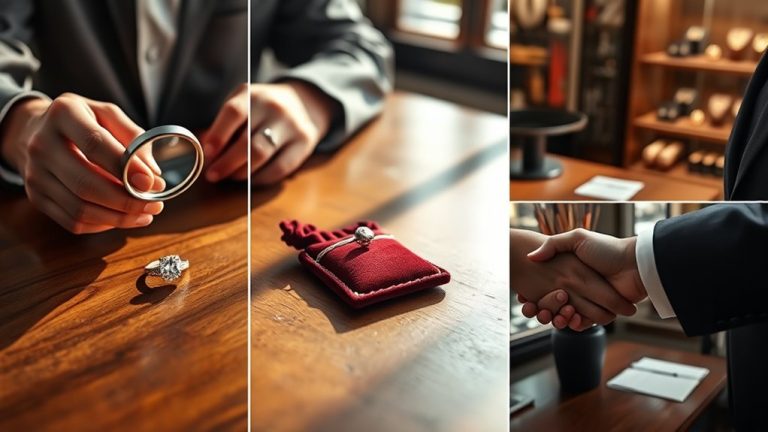
Though you can perform basic tests at home, consulting a professional jeweler gives you access to specialized tools and expertise that guarantee accurate verification of your jewelry’s authenticity.
Consulting a professional jeweler ensures precise and reliable authentication beyond basic home testing.
A professional jeweler uses advanced equipment like electronic testers, acid kits, and X-ray fluorescence to assess metals and gemstones precisely.
They carefully examine hallmarks, including assay office symbols and date letters, to confirm genuine origin and age.
Chemical tests conducted by experts reveal whether pieces are plated or counterfeit—tests that aren’t safe for amateurs to try.
This detailed verification assures you get a definitive assessment, especially for high-value items.
Frequently Asked Questions
How to Test if Jewelry Is Real at Home?
You can test jewelry at home by checking for stamps.
Doing a magnet test is also a good idea.
Try dropping it in water to see if it sinks.
Rubbing it on unglazed ceramic can help too.
Lastly, applying vinegar will show if there’s any discoloration.
These simple methods can help you determine if your jewelry is real!
How to Identify Real Jewelry?
You can identify real jewelry by checking for hallmarks, testing with a magnet, weighing it, and examining its finish.
Real gold won’t stick to a magnet and feels heavy.
Also, it has consistent color without flaking.
How Do I Know if My Jewellery Is Real?
You can gently confirm your jewelry’s authenticity by seeking its subtle signatures—hallmarks, weight, and reaction to magnets or vinegar.
These elegant tests reveal if your piece truly carries the timeless value you desire.
Just remember, checking these details can give you a clearer picture of what you’re working with.
How Can I Check My Jewelry at Home?
You can check your jewelry at home by looking for hallmarks.
Using a magnet to test for magnetism is another great method.
Dropping it in water to see if it sinks can also provide clues about its composition.
Applying vinegar for color changes is a simple test too.
Lastly, inspect worn areas for discoloration, as this can indicate the quality of the metal.
Conclusion
Now that you know these simple steps to verify your jewelry’s authenticity, you’re better equipped to protect your valuable pieces.
Did you know that nearly 30% of jewelry sold online is counterfeit? That’s a staggering number, and it shows why taking the time to test your jewelry matters.
By following these methods, you can avoid costly mistakes and wear your treasures with confidence.
It’s essential to be diligent and informed when investing in jewelry.
Knowing how to tell if jewelry is real can save you from disappointment and ensure that your collection remains genuine.
With these techniques, you can confidently assess your pieces and enjoy them without worry.
Take the time to test your jewelry and make sure it’s truly authentic.
You deserve to wear your treasures knowing they are the real deal!