How Do You Pawn Jewelry in 10 Essential Steps
To pawn your jewelry effectively, it’s essential to understand the process to get the best deal. Start by assessing the value of your items; check the metal purity and the quality of any gemstones.
Next, gather all relevant documents like receipts and identification.
Cleaning your jewelry is also a good idea, as it can enhance its appeal.
Now it’s time to do some research—find trustworthy pawn shops in your area.
When you visit a shop, bring your pieces for an expert evaluation.
After the evaluation, be prepared to negotiate loan terms based on the fair market value of your items.
Before signing any agreements, review the terms carefully.
Once everything is settled, you’ll receive your cash, so keep your pawn ticket safe for future reference.
There’s definitely more to know about each vital step, so stay informed to maximize your experience!
Assess the Value of Your Jewelry

Before you pawn your jewelry, you need to assess its value accurately.
Start by examining the metal content, as gold, silver, or platinum purity heavily influences jewelry valuation.
Begin by identifying the metal type and purity to determine your jewelry’s base value accurately.
Check for karat marks or fineness stamps to gauge the metal’s worth.
Next, evaluate the gemstone quality—consider the 4 Cs for diamonds: cut, color, clarity, and carat weight.
These factors considerably impact the appraisal.
Don’t forget to assess the jewelry’s overall condition; any damage, wear, or missing parts can lower its value.
Also, keep an eye on market demand since trends and popularity can cause fluctuations in price.
Gather All Relevant Documentation

Before heading to the pawnshop, make sure you have your ownership papers, authenticity certificates, and purchase receipts ready.
These documents prove your jewelry’s value and legitimacy.
Keeping them organized will help you present a strong case during the transaction.
Identify Ownership Papers
When you’re preparing to pawn your jewelry, gathering all relevant ownership papers is essential to prove authenticity and value.
Having the right documentation streamlines the process and boosts your credibility with the pawnbroker.
Make sure you collect everything that verifies your claim and the jewelry’s worth.
Focus on these key items:
- Receipts or proof of purchase showing ownership.
- Appraisal reports confirming authenticity and value.
- Original packaging or documentation with maker marks or serial numbers.
- Government-issued identification to match the ownership papers.
Collect Authenticity Certificates
Although gathering ownership papers is essential, collecting authenticity certificates is equally important for pawning your jewelry.
These certificates verify your piece’s genuineness and often increase the jewelry appraisal value.
Make sure to gather all relevant documentation, including certificates from jewelers and recent appraisals that clearly detail materials, gemstone quality, and craftsmanship.
Presenting authentic certificates builds trust with the pawn broker and can help you secure a higher loan amount.
Keep all documentation organized and stored safely so you can easily access it when you visit the pawn shop.
Without proper authenticity certificates, you might not get the full value your jewelry deserves, so don’t overlook this vital step in the pawning process.
Organize Purchase Receipts
Since you want to maximize your jewelry’s value, organizing all purchase receipts and related documentation is essential.
Purchase receipts prove authenticity and help pawnbrokers appraise your items accurately. Gather every document that verifies your jewelry’s value to strengthen your position during negotiations.
Make sure your documentation includes:
- Purchase receipts with date, price, and retailer details
- Authenticity certificates and appraisals
- Credit card statements or original packaging if receipts are missing
- Documents arranged chronologically to show clear ownership
Having organized purchase receipts and supporting paperwork not only confirms your jewelry’s authenticity but also speeds up the appraisal process.
This thorough documentation helps you secure better loan offers and makes pawning smoother, ensuring your valuables are properly recognized and valued.
Clean and Prepare Your Jewelry for Presentation

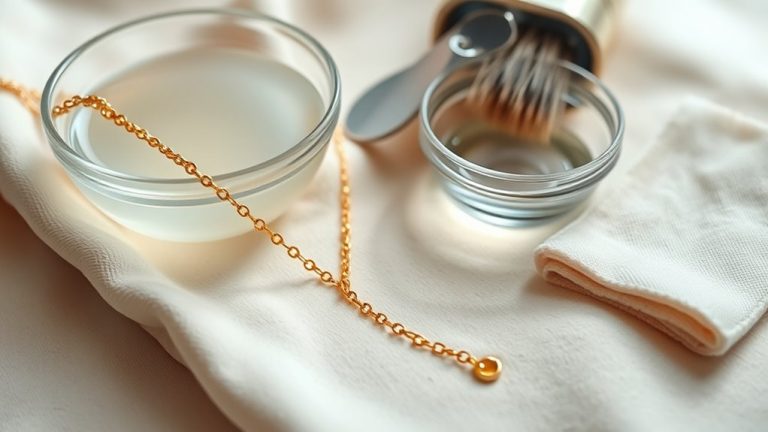
Before presenting your jewelry, clean each piece thoroughly using mild soap and warm water or a specialized cleaning solution. This will help remove dirt and oils that can dull its appearance.
Proper cleaning and preparation enhance presentation and reveal the true shine of your jewelry.
Next, inspect each piece carefully to ensure gemstones are secure and there’s no damage.
Remove any tarnish with a soft cloth, and organize your items neatly.
It’s best to use original boxes or cloth pouches to prevent scratches.
| Step | Action |
|---|---|
| Cleaning | Use mild soap or specialized solution |
| Inspection | Check for loose stones or damage |
| Tarnish Removal | Wipe with soft cloth |
| Organization | Use original boxes or pouches |
| Final Presentation | Arrange neatly for best impact |
Research Reputable Pawn Shops in Your Area
Start by identifying trusted pawn shops in your area through online reviews and personal recommendations.
Verify each shop’s licensing credentials to guarantee they operate legally and ethically.
Then, compare their loan offers, including interest rates and redemption terms, to find the best deal for your jewelry.
Identifying Trusted Pawn Shops
When you want to find a trustworthy pawn shop, you’ll need to research online reviews and verify their licensing to guarantee legitimacy.
Trusted pawn shops maintain a solid reputation by following local regulations and providing fair, transparent dealings.
Start by checking platforms like Google, Yelp, or Trustpilot to read honest reviews.
Also, ask friends or family for recommendations to get firsthand insights.
Don’t forget to confirm the pawn shop’s licensing status, which confirms their compliance and professionalism.
To identify trusted pawn shops, focus on:
- Positive reviews and high ratings
- Proper licensing and adherence to regulations
- Recommendations from people you trust
- A long-standing reputation for fairness and transparency
This approach ensures you choose a reputable place to pawn your jewelry confidently.
Comparing Loan Offers
After pinpointing trustworthy pawn shops, you’ll want to compare their loan offers carefully to get the best value for your jewelry.
Start by gathering appraised values from several shops. Pay close attention to how each compares to the current market price.
A fair price reflects both the quality of your piece and prevailing demand.
Don’t hesitate to ask about their evaluation process.
Also, find out if they provide immediate quotes or require an in-person assessment.
Consider each pawn shop’s reputation by reading reviews and checking ratings. This ensures transparency and professionalism.
Visiting shops in person can also help you gauge their credibility and service quality.
Verifying Licensing Credentials
Although finding a pawn shop that offers good loan terms is important, you should also verify their licensing credentials to protect yourself.
Ensuring the pawn shop follows local regulations helps avoid scams and guarantees a fair transaction.
Start by checking if the shop holds a valid license registered with your state or city authorities.
Perform a thorough verification by reviewing online ratings and confirming compliance with industry standards.
- Request to see official licenses or permits.
- Confirm membership in professional organizations like the National Pawnbrokers Association.
- Check the pawn shop’s website for licensing details.
- Contact consumer protection agencies for compliance history.
Visit the Pawn Shop With Your Jewelry and ID
Bringing your jewelry along with a valid government-issued ID, like a driver’s license or passport, guarantees the pawn shop can verify your identity quickly.
Make sure your jewelry is clean and well-presented to help the expert appraise its value accurately.
Present your ID at the counter as part of the standard procedure.
If you have any certificates or proof of authenticity, bring those too.
Arriving during business hours and following check-in steps ensures a smooth process.
| Jewelry Condition | ID Ready | Proof of Authenticity |
|---|---|---|
| Clean & Polished | Driver’s License | Certificates Present |
| Worn But Intact | Passport | None Available |
| Sparkling & Bright | State ID | Appraisal Included |
This careful presentation boosts confidence and speeds up the appraisal.
Allow the Expert to Evaluate Your Jewelry
Let the expert carefully assess your jewelry’s quality by testing the metal purity and examining hallmark stamps.
They’ll evaluate gemstones using the 4 Cs and review the overall craftsmanship to determine value.
Trust their techniques and market knowledge to get an accurate appraisal.
Jewelry Quality Assessment
When you bring your jewelry to an expert, they’ll test the metal’s purity with acid or electronic testers.
They’ll also examine hallmark stamps and engravings to confirm authenticity.
This guarantees accurate gold purity and hallmark verification.
They also perform a gemstone evaluation, looking at cut, color, clarity, and carat weight to determine true value.
Your jewelry condition is closely inspected for wear, damage, or missing parts.
Finally, the expert considers market demand, factoring in current trends to estimate resale potential.
These steps guarantee a thorough jewelry quality assessment.
- Gold purity tested with acid or electronic devices.
- Hallmark verification confirms authenticity and origin.
- Gemstone evaluation based on the 4 Cs.
- Jewelry condition checked for damage and wear.
This process helps you understand your piece’s worth before pawning.
Expert Valuation Techniques
After appraising the quality of your jewelry, the next step is to have an expert evaluate its value.
During the jewelry appraisal, the expert verifies metal purity through hallmark checks and tests like acid or electronic analyzers.
They assess gemstone quality by examining the 4 Cs—carat weight, cut, clarity, and color—to determine true worth.
Craftsmanship also plays a crucial role; the appraiser looks for maker’s marks, brand reputation, and provenance to confirm authenticity.
Condition matters too, as any damage or repairs can lower the market value.
Combining these factors with current market research, the expert provides an accurate, fair valuation.
Trusting this professional process ensures you receive the best possible offer when pawning your jewelry.
Negotiate the Loan Amount and Terms
Understanding how to negotiate the loan amount and terms can save you money and stress.
Before you start, research typical loan amounts for jewelry like yours to set realistic expectations.
Know that a pawn shop usually offers between 25% and 60% of your jewelry’s market value.
When you negotiate, focus on:
- Loan amount based on current market value and appraisal.
- Interest rates, fees, and repayment period.
- Maximum loan-to-value ratio the pawn shop allows.
- Clarity on due dates and penalties for late payment.
Use your knowledge of jewelry valuation to support your counteroffer.
This approach helps you secure fair terms and avoid surprises later.
Review and Sign the Pawn Agreement Carefully
Before you sign, make sure you carefully review all terms and conditions on the pawn agreement, including interest rates, fees, and repayment deadlines.
Double-check that the jewelry description, serial numbers, and appraisal details are accurate on the pawn ticket.
Understand the total redemption cost, which covers the principal, interest, and any extra fees, before finalizing your signing.
If any clauses or terms seem unclear or unfavorable, don’t hesitate to ask the pawn broker for clarification.
Remember, signing the agreement means you agree to these terms, so ensure you fully comprehend them.
Finally, keep a signed copy of the pawn agreement and pawn ticket in a safe place, as you’ll need them for redemption or reference during the loan period.
Receive Your Cash and Keep the Pawn Ticket Safe
Once you sign the pawn ticket detailing your loan amount, interest rate, and due date, you’ll receive your cash immediately.
This pawn ticket is a vital legal document that proves your loan agreement and outlines all key details.
To guarantee safety and a smooth process when you want to redeem your jewelry, keep the pawn ticket secure.
Losing it can complicate retrieval or repayment.
Remember to:
- Store the pawn ticket in a safe, easily accessible place.
- Verify it includes your jewelry’s description and repayment amount.
- Treat it as your only proof of the loan agreement.
- Avoid lending it to others or leaving it unattended.
Keeping the pawn ticket safe safeguards your ability to redeem your jewelry without issues.
Repay the Loan Within the Agreed Timeframe to Redeem Your Jewelry
If you want to get your jewelry back, you’ll need to repay the full loan amount along with any interest and fees by the due date on your pawn ticket.
Timely repayment is vital because missing this deadline means you forfeit your collateral, and the pawn shop can legally resell your item.
Make sure you understand the total amount owed and keep track of the due date to avoid unintentional loss.
If you can’t repay on time, some pawn shops may offer extensions or grace periods, but these usually come with extra fees.
Staying on top of your repayment schedule ensures you retain ownership and successfully redeem your jewelry without hassle.
Always keep your pawn ticket safe—it’s proof of your agreement and essential for redemption.
Frequently Asked Questions
How Much Will a Pawn Shop Give You for a $1000 Item?
You can expect a pawn shop to offer you between $400 and $600 for a $1000 item,
depending on its condition, brand, and market demand.
Negotiation might help you get a slightly better deal.
Who Pays the Highest for Jewelry?
You’ll get the highest price from luxury jewelry buyers, specialized appraisers, or high-end pawn shops.
They value branded, vintage, or high-purity gold pieces.
Often, they pay more when you provide certified appraisals and provenance.
How Do Pawn Shops Determine the Value of Jewelry?
Did you know pawn shops assess jewelry value by weight and purity, especially gold karats?
They test metals and examine gemstones using the 4 Cs.
Plus, they check hallmarks and consider brand and condition to offer you a fair price.
What Is Worth $500 at a Pawn Shop?
You’ll find jewelry worth $500 at a pawn shop if it’s high-karat gold, valuable diamonds, or designer pieces with certification.
The weight, purity, and brand all boost its value, so bring proof and condition details.
Conclusion
Pawning your jewelry might feel intimidating, but it’s simpler than you think.
By following these steps, you’ll confidently get a fair loan without hidden surprises.
Imagine walking into a trusted pawn shop, jewelry in hand, knowing exactly what to expect—no stress, just a straightforward process.
Keep your pawn ticket safe, and you’ll easily reclaim your piece later.
With preparation and care, pawning can be a smart, hassle-free way to get quick cash.
So, if you’re in need of some quick funds, pawning your jewelry could be the perfect solution.
Remember to research pawn shops in your area, understand the value of your jewelry, and be ready to negotiate.
With these tips, you’ll navigate the process smoothly and leave with cash in your pocket.
In conclusion, pawning your jewelry doesn’t have to be a daunting experience.
With the right preparations and a clear understanding of the process, you can get the cash you need quickly and efficiently.
Don’t forget to keep your pawn ticket safe for easy retrieval later on!