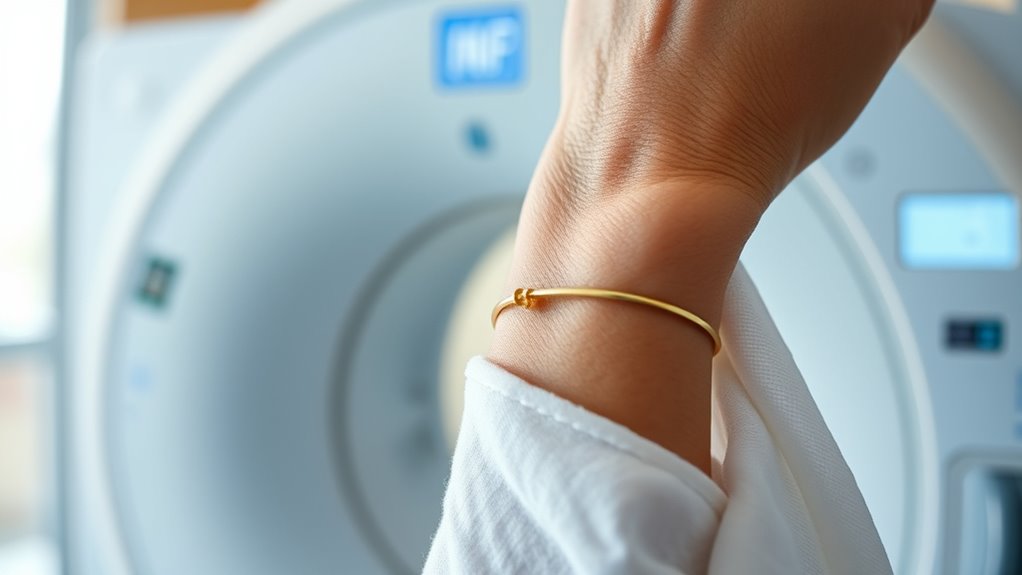
How You Can Safely Wear Gold Jewelry During an MRI
You should always tell the MRI technologist if you’re wearing gold jewelry before your scan.
While pure gold is generally safe and weakly magnetic, some gold alloys can cause image distortion or slight heating.
It’s best to remove all metal jewelry to avoid any risks or discomfort during the MRI.
If removal isn’t possible, the staff will assess safety and image quality.
Keep going to understand how to protect both yourself and your scan results.
Understanding the Impact of Metal in MRI Scans

How does metal, like gold, affect your MRI scan?
Metal objects, including gold, interact with the MRI’s strong magnetic field.
Even though gold is diamagnetic and weakly attracted, it can still cause image distortion or artifacts, which reduces the clarity of your MRI results.
Additionally, metal objects can heat up slightly during the scan due to radiofrequency energy.
This might lead to discomfort or even burns.
Because any metal presence can interfere with the magnetic field’s uniformity, it’s best to remove all jewelry before your MRI.
This guarantees the images are accurate and your safety is prioritized.
Why Gold Jewelry Requires Special Consideration

Although gold is less magnetic than other metals, you still need to contemplate certain factors before wearing gold jewelry during an MRI.
Gold is diamagnetic, so it’s minimally attracted to the strong magnet in the MRI machine and less likely to shift or move.
Unlike ferromagnetic metals, pure gold jewelry usually doesn’t heat up considerably, reducing risk.
However, many gold pieces contain alloys or other metals, which might interfere with the imaging or pose safety concerns.
This means not all gold jewelry behaves the same under the strong magnet’s influence.
To guarantee your safety and get the best scan results, it’s important to check with MRI staff about your specific jewelry before the procedure.
Steps to Take Before Your MRI Appointment

Before your MRI appointment, you should inform the technologist if you plan to wear gold jewelry.
It can sometimes affect imaging, despite being generally non-magnetic.
Remove all metal jewelry, including rings, necklaces, and bracelets, especially if the jewelry is near the area being scanned.
If you have permanent jewelry or pieces you can’t remove, let the staff know so they can assess any risks or imaging issues.
Check with your healthcare provider or MRI staff if you’re unsure whether your gold jewelry contains magnetic alloys or other metals.
To avoid loss or damage, consider leaving your jewelry at home or in a secure place.
Always follow any specific instructions the MRI facility gives regarding jewelry removal or wearing minimal accessories for the best imaging results.
Communicating With MRI Technologists About Your Jewelry
Since gold jewelry can sometimes impact MRI safety and imaging quality,
you should always inform the technologist about any pieces you’re wearing.
Machines use powerful magnets that can interact with metal, so clearly specify the type and location of your gold jewelry—whether it’s a necklace, ring, or bracelet.
This helps the MRI technologist assess any risks and decide if you need to remove your jewelry before entering the MRI scanner.
Don’t hesitate to share any concerns or questions you have about your jewelry;
open communication ensures the staff can take proper safety measures.
By providing detailed information, you help prevent image distortion and potential hazards during your MRI scan,
keeping the procedure safe and effective.
Alternatives and Tips for Wearing Jewelry Safely Around MRI Procedures
When preparing for an MRI, you should remove all jewelry whenever possible to avoid risks, especially if your gold pieces contain mixed metals or unknown components.
The short answer: gold is generally safe but can still distort images or cause issues.
The bottom line is to prioritize safety by consulting your MRI technician about your specific jewelry.
If you must wear something, consider alternatives like jewelry with non-metallic or plastic settings, or covering your gold piece with an approved MRI-safe material.
Always follow your healthcare provider’s instructions carefully.
By taking these precautions, you reduce potential risks and ensure clear imaging results.
Frequently Asked Questions
What if I Can’t Remove My Jewelry for an MRI?
If you can’t remove your jewelry for an MRI, tell the technician beforehand.
They’ll assess risks and decide if you can keep it on without affecting the scan.
Always follow their guidance for safety and image quality.
Is 14K Gold Okay in MRI?
Yes, 14k gold is generally safe during an MRI since it’s mostly non-magnetic.
But you should always tell the technician about your jewelry to guarantee it won’t interfere with imaging or cause any safety issues.
What Happens if You Accidentally Wear Metal in an MRI?
If you accidentally wear metal in an MRI, it can move suddenly, cause burns, distort images, and even damage tissues or the machine.
Always remove all metal to keep yourself and the MRI safe.
What Jewelry Metals Are MRI Safe?
About 75% of metals, like gold, silver, and titanium, are MRI-safe because they’re non-ferromagnetic.
You shouldn’t wear metals containing iron, nickel, or cobalt since they can interfere with imaging or cause hazards during scans.
It’s always best to check with your healthcare provider if you’re unsure about any specific jewelry before an MRI.
Conclusion
Did you know that nearly 70% of MRI-related injuries involve metal objects like jewelry?
To stay safe, always remove gold jewelry before your MRI or let the technologist know if you’re wearing any.
Gold isn’t magnetic but can still heat up or cause image distortions, so taking precautions matters.
By following simple steps and communicating clearly, you’ll safeguard yourself and ensure your MRI results are accurate every time.
In conclusion, while gold jewelry may not be magnetic, it’s still crucial to remove it before an MRI.
Doing so helps prevent any potential heating or image interference.
Prioritizing safety and clear communication with the MRI staff will help you achieve the best possible results during your scan.
Remember, it’s always better to be safe than sorry when it comes to your health!