How to Know if Jewelry Is Gold With a Step-By-Step Guide
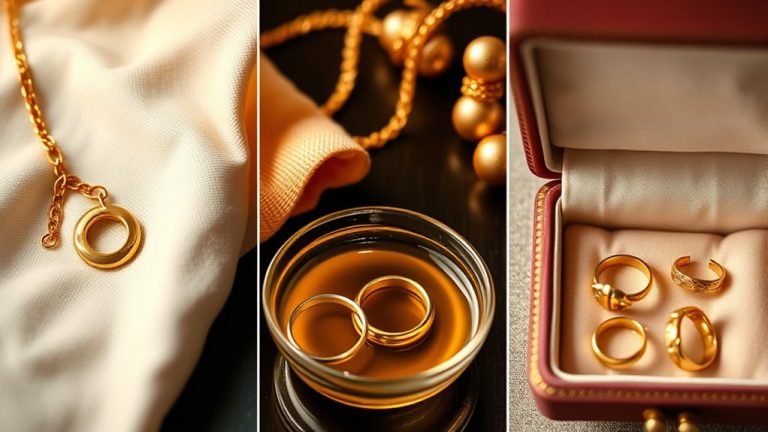
To know if your jewelry is gold, start by checking for karat stamps like 14K, 18K, or numbers like 585 that indicate purity.
These stamps are usually found on the inside of rings or on the clasps of necklaces and bracelets.
Next, inspect the color for consistent warmth; genuine gold has a rich, warm hue.
Also, look for any signs of wear or tarnish, as gold typically resists these issues.
Try a magnet test—gold isn’t magnetic, so if your piece is attracted to a magnet, it’s likely fake.
You can also use household tests, like the vinegar or bleach test, or consider investing in electronic gold testers for more accuracy.
Keep going, and you’ll discover detailed methods to confidently verify your gold’s authenticity.
Understanding Gold Purity and Karat Marks
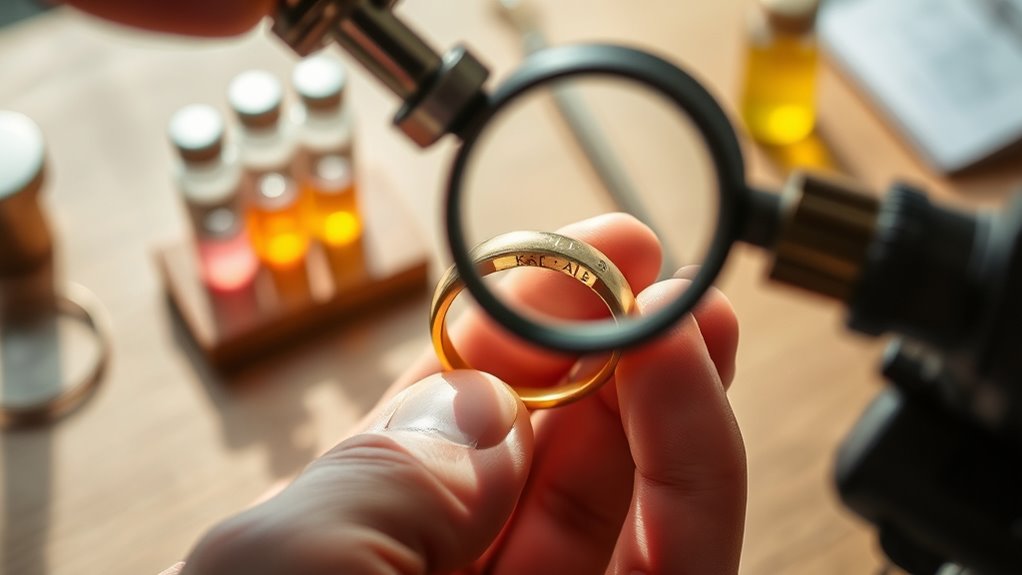
Although gold comes in various forms, understanding its purity is key to identifying genuine pieces.
Gold purity is measured in karats, with 24K representing pure gold, nearly 99.9% free of any gold alloy.
Gold purity is measured in karats; 24K signifies nearly 99.9% pure gold without alloy.
When you examine jewelry, look for karat marks like 10K, 14K, or 18K gold, which tell you the proportion of pure gold mixed with other metals.
For example, 18K gold contains 75% pure gold, often indicated by hallmark stamps such as “750.”
These markings help you quickly assess quality without extensive testing methods.
Keep in mind that higher karats, like 22K, are softer but more valuable, while lower karats offer better durability.
Knowing these basics guarantees you can confidently identify authentic gold pieces.
Identifying Hallmarks and Stamps on Jewelry
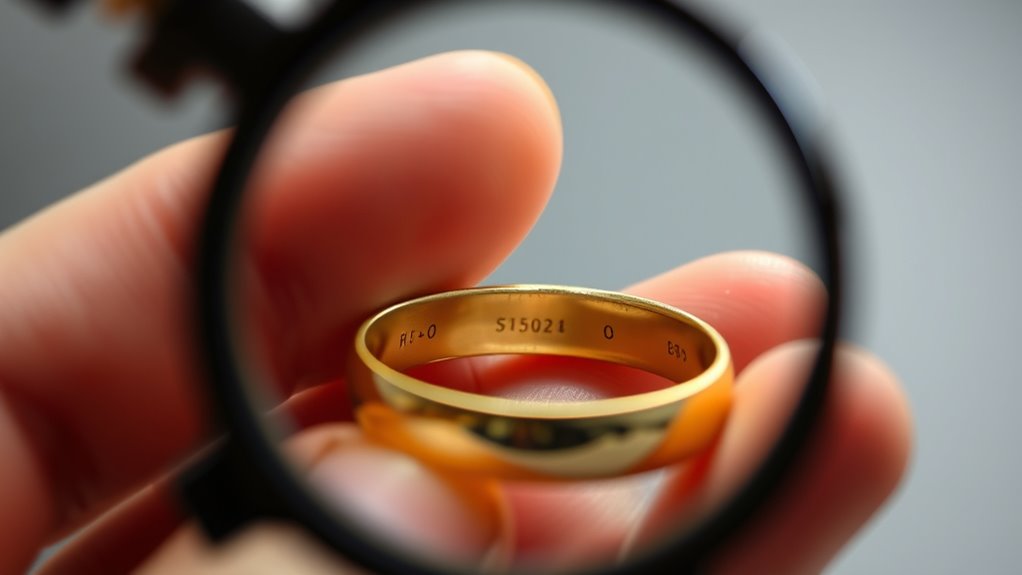
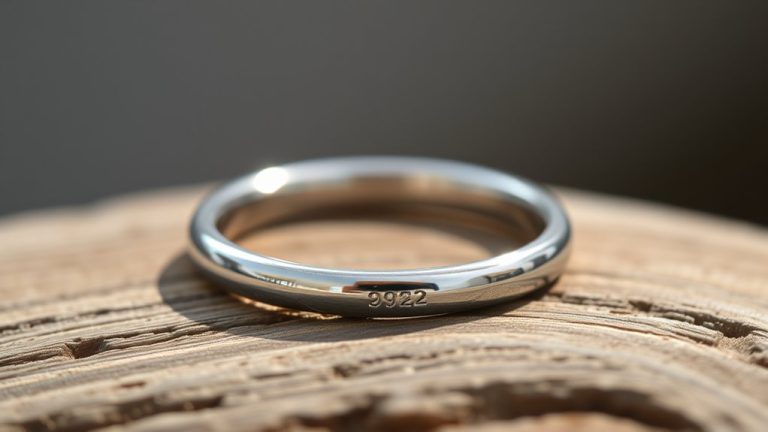
When you examine jewelry, check for small stamped markings inside rings, on clasps, or the backs of pendants that indicate the gold’s karat or purity, such as “14K,” “18K,” or “750.”
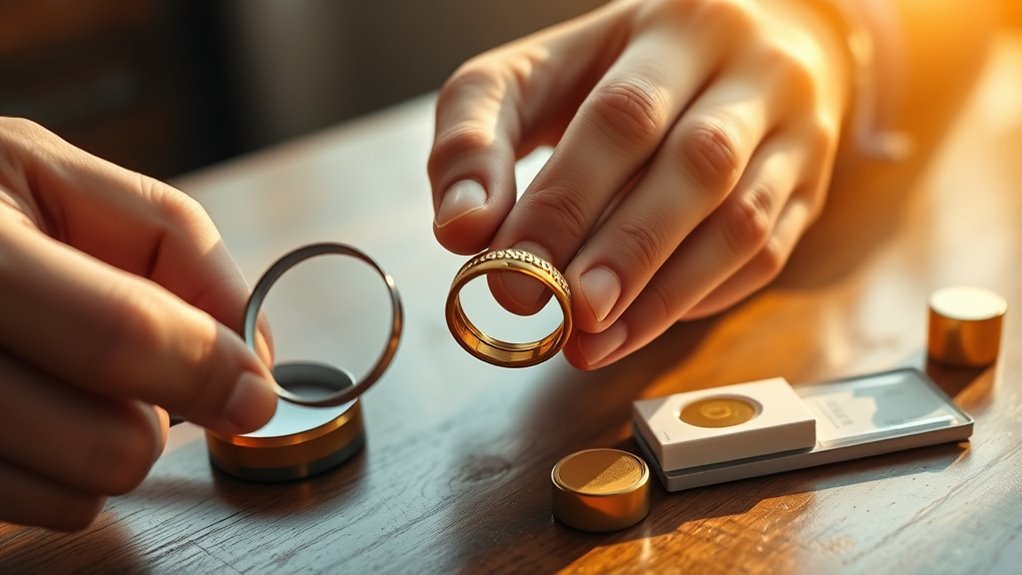
Use a magnifying glass for detailed hallmark inspection and compare hallmark symbols against official hallmarking standards to guarantee authenticity.
Be cautious of fake stamps with uneven engraving or misspellings. Remember, vintage pieces might lack hallmarks, so combine hallmark verification with other tests.
| Marking | Purity (%) | Region |
|---|---|---|
| 14K | 58.5 | United States |
| 18K | 75.0 | United States |
| 585 | 58.5 | Europe |
| 750 | 75.0 | Europe |
These jewelry markings help confirm genuine gold.
Visual Inspection: Color, Wear, and Tarnish Signs

After checking for hallmarks and stamps, take a close look at the jewelry’s color, wear, and tarnish signs.
Genuine gold usually has a consistent, warm yellow color with a natural shine that doesn’t fade.
If you notice uneven color or discoloration, especially at edges or areas with heavy wear, it might be plated or mixed with other metals.
Scratches that reveal a different metal underneath are a clear sign of plating rather than solid gold.
Tarnish or a greenish patina isn’t typical for real gold, which resists corrosion and keeps its shine.
Pay attention to any dullness or unusual wear patterns, as these can indicate lower purity or fake gold.
This visual inspection helps you quickly identify if the piece is likely genuine or not.
Performing the Magnet Test for Gold Verification
Since gold is non-magnetic, you can use a strong magnet to help verify if your jewelry is genuine.
For the magnet test, grab a neodymium or rare-earth magnet, as weaker magnets might not detect ferromagnetic metals hidden in the piece.
Hold the magnet close to your jewelry without touching it and watch for any movement. If the jewelry is attracted to the magnet, it likely contains ferromagnetic metals, indicating it may not be pure gold or could be gold-plated.
Keep in mind, some gold alloys may include small amounts of magnetic metals, so this test alone can’t confirm authenticity.
However, if there’s no reaction, it suggests your jewelry is more likely genuine gold or a gold alloy free from ferromagnetic metals.
Using Household Items for Simple Gold Tests
You can use simple household items like vinegar and a magnet to test your jewelry’s authenticity.
Real gold won’t react to a magnet and usually stays unchanged when exposed to vinegar.
On the other hand, fake pieces might show discoloration or stick to the magnet.
Checking for visual wear and tarnish can also help you spot if the gold is genuine or just gold-plated.
Vinegar and Magnet Tests
Though simple, the vinegar and magnet tests offer quick ways to check if your jewelry might be gold using items you probably already have at home.
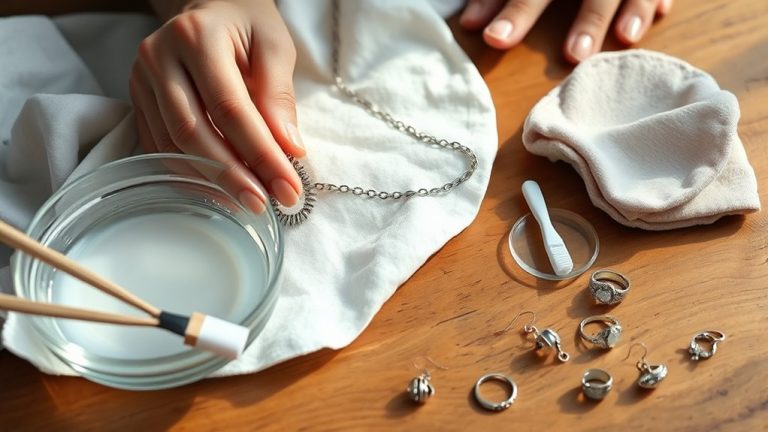
For the vinegar test, soak gold jewelry in white vinegar for 15-30 minutes. Real gold usually stays the same or changes slightly, while fake gold often dulls or discolors.
The magnet test involves holding a strong magnet near the piece. Real gold is non-magnetic, so if it sticks, it’s likely not genuine.
Try these checks:
- Soak your jewelry in vinegar and watch for color changes.
- Use a strong magnet to test attraction.
- Look for dullness or discoloration after vinegar exposure.
- Confirm non-magnetic behavior for authenticity.
These quick tests help spot fake gold but should be paired with other methods.
Visual Wear and Tarnish
Beyond vinegar and magnet tests, examining your jewelry’s appearance can reveal clues about its authenticity.
Genuine gold resists tarnish and maintains a consistent warm color, even with regular wear and tear.
Look closely for scratches or signs of wear where the gold layer might have worn off, exposing another metal underneath.
Discoloration or greenish marks on your skin after wearing the piece often indicate non-gold alloys or plating.
Uneven color, dullness, or flaking suggest lower-karat gold or gold-plated items rather than pure gold.
How to Use Acid Testing Kits Safely and Effectively
When using acid testing kits to verify gold purity, always wear protective gloves and eye protection to prevent chemical burns or irritation.
Start by choosing a discreet spot on the jewelry for the scratch test to avoid damaging visible areas.
Apply a small drop of the correct acid and watch the acid reaction closely.
Compare the results with the color chart to identify the gold’s karat.
After testing, rinse the piece with water and neutralize the acid with baking soda to safeguard your jewelry.
- Wear protective gloves and goggles
- Scratch a hidden area gently
- Apply acid and observe color change
- Rinse and neutralize with baking soda
This careful process ensures accurate acid testing while protecting both you and your jewelry.
Exploring Electronic Gold Testers for Accuracy
You can use electronic gold testers to quickly measure your jewelry’s gold content by checking its conductivity.
These devices offer more precise results than acid tests and are easy to use with just a simple touch.
However, you should be aware of their accuracy limits and the need for regular calibration to get reliable readings.
How Electronic Testers Work
How exactly do electronic gold testers determine the authenticity of your jewelry?
They measure the electrical conductivity of the metal using probes that touch its surface.
By sending a small electrical current through the piece, these testers analyze how the metal responds to estimate its karat purity.
Calibration with known gold standards ensures accurate readings every time.
Because this method is non-destructive, you won’t damage delicate or valuable items during testing.
When you use an electronic gold tester, envision this process:
- Probes contacting the jewelry’s surface precisely
- Electrical current flowing through the metal
- Device comparing results to calibrated karat purity standards
- Instant, accurate readings displayed on the screen
This technology offers a reliable way to verify gold content without harming your precious pieces.
Benefits Over Acid Tests
Although acid tests have long been a standard for checking gold purity, electronic gold testers offer you a faster, non-invasive alternative.
These testers deliver instant and precise results without damaging your jewelry.
By measuring conductivity, they provide reliable jewelry verification without scratching or using chemicals.
The digital display clearly shows gold purity, allowing you to quickly distinguish real gold from plated or fake items.
This makes electronic testers especially valuable for frequent testing.
| Feature | Benefit |
|---|---|
| Non-invasive | Protects your jewelry surface |
| Instant results | Saves time |
| Digital display | Shows precise karat or purity |
| Conductivity-based | Accurate gold verification |
| Reliability | Trusted by jewelers and collectors |
Accuracy and Limitations
Electronic gold testers offer quick and non-invasive gold verification, but understanding their accuracy and limitations helps you utilize them effectively.
These testing kits measure metal conductivity with about 1-2% accuracy, provided you calibrate the device properly and follow instructions carefully.
Keep in mind, surface contamination or oxidation can skew your results if the jewelry isn’t cleaned beforehand.
Also, some alloys or plated jewelry may present challenges, as the tester might not fully detect underlying metals, requiring further analysis.
To ensure reliable readings, calibrate your electronic gold tester regularly.
Don’t forget to clean jewelry to remove surface contamination before testing.
Be cautious with plated jewelry and mixed alloys, as they can affect the results.
If results seem inconsistent, it’s a good idea to use additional methods for verification.
Knowing these limits ensures your tests stay accurate and trustworthy.
When to Seek Professional Appraisal and Testing
If your visual inspection and home tests don’t give clear answers, it’s time to seek a professional appraisal and testing.
A professional jeweler can provide an accurate identification using advanced tools like X-ray fluorescence (XRF) analyzers. This ensures precise and non-destructive gold testing.
Certified jewelers are especially skilled at evaluating pieces that lack hallmarks or show suspicious markings, wear, or discoloration.
They’ll offer a detailed report on your jewelry’s purity, weight, and current market value, which is essential for high-value items.
Relying on experts not only confirms authenticity but also protects you from misidentification.
Always choose reputable jewelry stores or assay offices for your appraisal to guarantee reliable results and peace of mind about your treasured gold pieces.
Frequently Asked Questions
How to Test if Jewelry Is Gold?
You can test if jewelry is gold by checking for hallmarks, using a magnet, or performing a vinegar soak.
These methods help you quickly identify real gold.
For a more hands-on approach, you can scratch it on ceramic or use a gold testing kit.
Each of these steps offers a different way to confirm the authenticity of your jewelry.
What Are the Two Letters for Gold?
When you spot “14K” on your grandma’s ring, those two letters, “K” for karat, tell you the gold purity.
You’ll often see “K” or “CT” marking gold’s quality or weight on jewelry pieces.
Does Real Gold React With Vinegar?
No, real gold doesn’t react with vinegar.
If you soak your jewelry and see no change, it’s likely genuine.
Just test a small area first, since alloys might show slight reactions or discoloration.
How to Identify Gold Jewellery at Home?
Think of your jewelry as a secret book; you can open its truth by checking for stamps,
using a magnet, applying vinegar, and testing density.
These simple home tricks help you reveal if it’s real gold or not.
Conclusion
Now that you’ve navigated the nuances of knowing if your jewelry is genuine gold, you’re equipped to confidently check karat marks, conduct clever tests, and spot subtle signs of authenticity.
Whether you’re handling household hacks or harnessing high-tech testers, remember that patience and precision pave the path to perfect proof.
If doubts dazzle, don’t delay—seek seasoned specialists to secure your sparkling success and safeguard your shining treasures.
In conclusion, knowing how to identify genuine gold jewelry involves a mix of practical tests and keen observation.
Always look for karat marks and perform simple at-home tests.
If you’re ever unsure, consulting a professional can provide peace of mind and ensure your valuable pieces remain safe and genuine.