
How Do You Know If Gold Jewelry Is Real Step by Step
You can tell if gold jewelry is real by first checking for karat stamps and hallmarks while inspecting its consistent color and weight.
Start by looking for any markings that indicate the gold’s purity, such as 10K, 14K, or 18K.
Next, examine the jewelry for any discoloration or inconsistencies in color, which can indicate it’s not real gold.
Try simple tests like a magnet check, vinegar reaction, or ceramic scratch for quick clues.
A magnet won’t attract real gold, while vinegar can cause fake gold to tarnish.
For more accuracy, consider acid testing or electronic kits to assess purity.
Watch for discoloration or skin stains that signal fakes.
Keep going, and you’ll uncover detailed ways to confidently verify your gold’s authenticity step by step.
Identifying Authentic Gold Through Karat Markings and Hallmarks
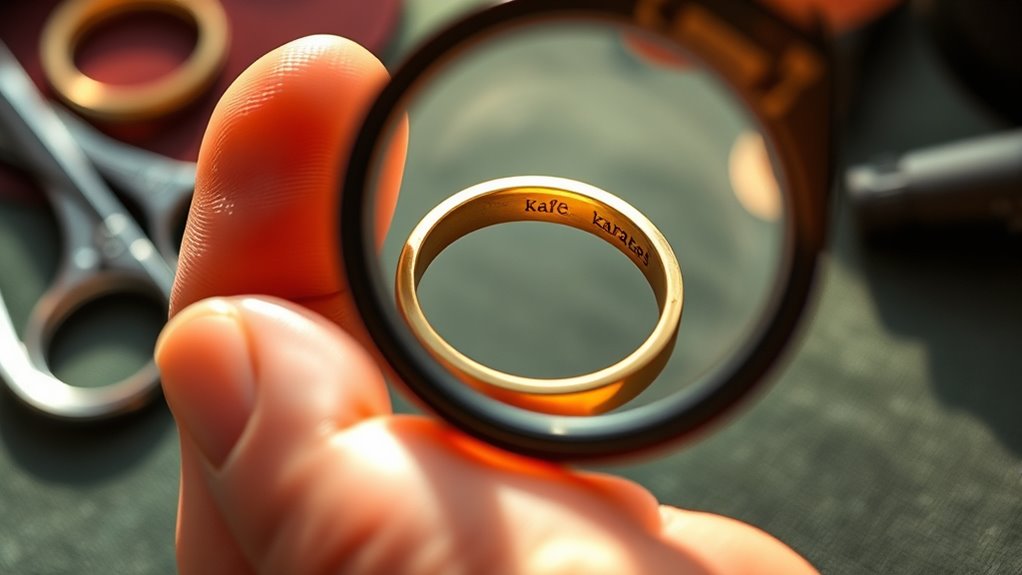
When you’re trying to determine if gold jewelry is genuine, checking for karat markings and hallmarks is a crucial first step.
These stamps, like 10K, 14K, 18K, or 24K, indicate the purity of the gold, with higher karat markings showing a greater percentage of pure gold.
You’ll usually find these marks inside the band or clasp.
Hallmarks often include a manufacturer’s mark or assay office stamp, reinforcing authenticity.
However, since karat markings can be forged, don’t rely on them alone.
Look for clear, consistent engravings, especially in areas prone to wear.
To be confident about authenticity, combine this visual check with other testing methods or seek a professional appraisal.
This helps ensure your gold jewelry is truly genuine.
Visual and Physical Characteristics of Real Gold

Although karat markings provide some clues, you can often tell real gold by its visual and physical traits.
Genuine gold has a consistent, warm yellow hue that won’t fade or tarnish over time.
Real gold maintains a rich, warm yellow color that stays vibrant and never tarnishes.
When you hold gold jewelry, you’ll notice it feels heavier than similar-sized pieces made from brass or gold-plated materials because of gold’s high density.
Look closely for hallmarks stamped inside rings or on clasps—clear markings like 14K, 18K, or 24K signal authenticity.
Unlike fakes, real gold won’t develop green or black stains, which are signs of tarnish on plated metals.
Plus, real gold is soft and malleable, so if you gently bend it, it won’t crack or snap like counterfeit metals do.
These traits help you visually and physically confirm genuine gold.
Simple At-Home Tests to Verify Gold Authenticity

You can complement the visual and physical checks by trying simple tests at home to confirm if your gold jewelry is authentic.
Start with the magnet test: real gold isn’t magnetic, so if your piece sticks to a strong magnet, it’s likely fake.
Next, try the vinegar test—apply vinegar to your jewelry and watch for any color change; real gold won’t tarnish.
You can also scratch the piece gently on an unglazed ceramic tile; a gold streak means it’s genuine, while a black streak suggests otherwise.
Although gold testing kits and acid tests offer more precise results, these quick at-home methods give you a reliable first impression before moving on to professional testing.
Using Acid and Electronic Testing Kits for Accurate Results
To get precise results, you’ll want to use acid testing kits by scratching your jewelry on a stone and applying specific acids to see how it reacts.
Electronic testers offer a quick, non-damaging way to measure gold’s purity through conductivity.
Just remember to follow safety precautions and calibrate your devices properly for the best accuracy.
Acid Testing Procedures
When testing gold jewelry, acid testing provides a reliable way to determine its purity by applying specific acids to a scratched sample on a testing stone.
You’ll need a testing kit containing various acids tailored for different gold purities—like 10K, 14K, 18K, and 22K.
First, scratch a small area of your jewelry onto the stone, then carefully apply a drop of each acid to see how the metal reacts.
If the metal dissolves or changes color, it indicates a lower karat; if it resists, you’re likely dealing with higher gold purity.
Always wear gloves and goggles, and work in a ventilated space to stay safe.
Compare your results with known gold samples, and if you’re unsure, seek professional verification for accuracy.
Electronic Tester Benefits
Electronic gold testers offer a fast and non-destructive way to verify your jewelry’s purity by measuring its electrical conductivity.
Using an electronic gold tester guarantees accurate gold verification without damaging your pieces, unlike some traditional methods.
When combined with acid testing, you get a reliable double-check for authenticity.
Here’s why you’ll appreciate using an electronic gold tester:
- Provides instant results with minimal effort.
- Employs non-destructive testing, preserving your jewelry.
- Reduces human error thanks to consistent calibration.
Safety Precautions
Although gold testing kits are invaluable tools, you should always prioritize safety to protect yourself and your jewelry.
When handling acid testing kits, wear protective gloves and eye goggles to prevent skin and eye irritation from corrosive chemicals.
Apply acids only to small, inconspicuous areas of the jewelry, following the manufacturer’s instructions closely to avoid damage and get accurate results.
Always conduct tests in a well-ventilated space to minimize inhaling fumes.
For electronic gold testers, calibrate them regularly using known reference samples to ensure precision and prevent false readings.
Store acids and testing devices securely, out of reach of children and pets, to avoid accidental ingestion or misuse.
Taking these precautions helps guarantee safe, reliable gold testing every time.
Advanced Scientific Methods for Gold Verification
You can use electronic gold testers to quickly check purity by measuring conductivity without harming your jewelry.
X-Ray Fluorescence (XRF) analysis offers precise, non-destructive elemental readings to confirm authenticity.
Specific gravity measurement helps you verify gold’s density, distinguishing real pieces from fakes with ease.
Electronic Gold Testing
When you want a quick and accurate way to verify gold purity, electronic gold testers come into play.
These devices measure the electrical conductivity of your jewelry to determine its gold content with precision.
Best of all, electronic gold testing is non-destructive, so you won’t damage your precious pieces while checking authenticity.
For reliable results, you’ll need to calibrate the tester using known gold samples.
Then, simply place the metal probe against the jewelry’s surface to get a reading.
Why choose electronic gold testing?
- Provides fast, precise gold testing results
- Uses conductivity to detect gold purity levels
- Non-destructive method, perfect for valuable or ambiguous items
This method is trusted by professionals and ideal for confirming your gold’s authenticity efficiently.
XRF Elemental Analysis
Electronic gold testers offer quick and accurate results by measuring conductivity, but for an even more detailed assessment, XRF elemental analysis provides a scientific edge.
With XRF analysis, you can determine the exact elemental composition of your gold jewelry without any damage, thanks to its non-destructive testing method.
This technique uses X-rays to make the elements in your piece fluoresce, allowing sensors to precisely identify the percentage of gold and any alloys present.
Because it’s highly accurate and fast, XRF analysis is widely trusted by jewelers and assayers for verifying gold’s authenticity and purity.
If you want the most reliable way to confirm your gold’s quality, XRF elemental analysis is the advanced tool you’ll want to rely on.
Specific Gravity Measurement
Although it requires some specialized equipment, specific gravity measurement offers one of the most precise ways to verify gold’s authenticity by comparing its density to that of pure gold.
You weigh the gold jewelry first in air, then submerged in water, calculating the ratio to determine its specific gravity.
Since pure gold has a specific gravity of about 19.3 g/cm³, any significant deviation suggests counterfeit gold or an alloyed piece.
This method stands out for its accuracy in distinguishing real gold from fakes.
Here’s what you need to know:
- Weigh gold jewelry accurately in air and water.
- Calculate specific gravity using the weight difference.
- Compare results to pure gold’s density to spot counterfeit gold.
Specific gravity testing suits professionals and serious hobbyists aiming for reliable results.
Recognizing Common Signs of Fake Gold and Avoiding Scams
Since gold jewelry can be costly, you need to spot fake pieces before making a purchase.
First, check for a clear hallmark—authentic gold usually carries marks like 14K or 18K. Be wary of missing or suspicious stamps.
Look for clear hallmarks like 14K or 18K; missing or odd stamps can signal fake gold.
Look closely for discoloration or any green or black skin reactions, which often indicate plating or fake metals.
Real gold has a distinct weight, so if the piece feels unusually light, it might be fake.
Use a magnet to test it—gold isn’t magnetic, so if the jewelry sticks, it’s likely counterfeit.
Finally, avoid deals that seem too good to be true or sellers without proper certification; these are common scam signs.
Trust your instincts and verify before buying to protect yourself.
Frequently Asked Questions
How to Test if Your Jewelry Is Real Gold at Home?
You can test your gold jewelry at home by checking if it’s magnetic.
If it’s not, that’s a good sign!
Next, try a ceramic scratch test.
Just scratch it against an unglazed ceramic surface.
If you see a gold streak, it’s real!
You can also drop it in water to see if it sinks.
Real gold is dense and will sink.
Another method is applying vinegar to check for color changes.
If it changes color, it’s likely not real gold.
Lastly, you can use a gold testing kit carefully if you have one.
This can give you a more definitive answer.
What Are Signs of Fake Gold?
You’ll notice fake gold’s dull color and feel lighter weight.
Also, you might see green or black discoloration.
Look for suspicious stamps and wear revealing base metal.
Scratches or flaking also signal your gold might be fake.
Conclusion
Now that you know how to spot real gold, you’re better equipped to avoid fakes.
Did you know nearly 30% of gold jewelry sold worldwide is counterfeit?
That’s why checking karat markings, doing simple home tests, and using acid or electronic kits can save you from costly mistakes.
With these steps, you’ll confidently verify your gold’s authenticity and protect your investment every time.
Stay sharp and trust your instincts!
In conclusion, understanding how to identify real gold jewelry is essential for safeguarding your finances.
By familiarizing yourself with karat markings and employing simple tests, you’re taking proactive steps against counterfeit pieces.
Remember, nearly a third of gold jewelry on the market can be fake, so vigilance is key.
With these strategies, you’ll be better prepared to distinguish genuine gold from imitations and ensure your investment remains secure.