How to Tell if Your Jewelry Is Real With a Step-By-Step Guide
To tell if your jewelry is real, start by checking for small hallmarks like “14K” or “925” using a magnifying glass.
Feel its weight—real gold is heavy and won’t tarnish or discolor your skin.
Try simple tests: use a magnet (real gold isn’t magnetic) or scratch on ceramic (real gold leaves a gold streak).
You can also measure its density by water displacement.
For a precise answer, acid testing helps.
Keep going to uncover more reliable ways to verify your prized pieces.
Identifying Hallmarks and Purity Stamps

When you’re checking if your jewelry is real, start by looking for hallmarks and purity stamps.
These small engravings or metal markings reveal the purity level and sometimes the origin of the piece.
Small engravings or markings disclose the purity and occasionally the origin of your jewelry piece.
Common hallmark symbols like “14K,” “18K,” “925,” or “750” indicate gold karats or silver fineness.
You’ll often find these purity stamps on the inner band of rings, necklace clasps, or earring backs, usually in discreet spots.
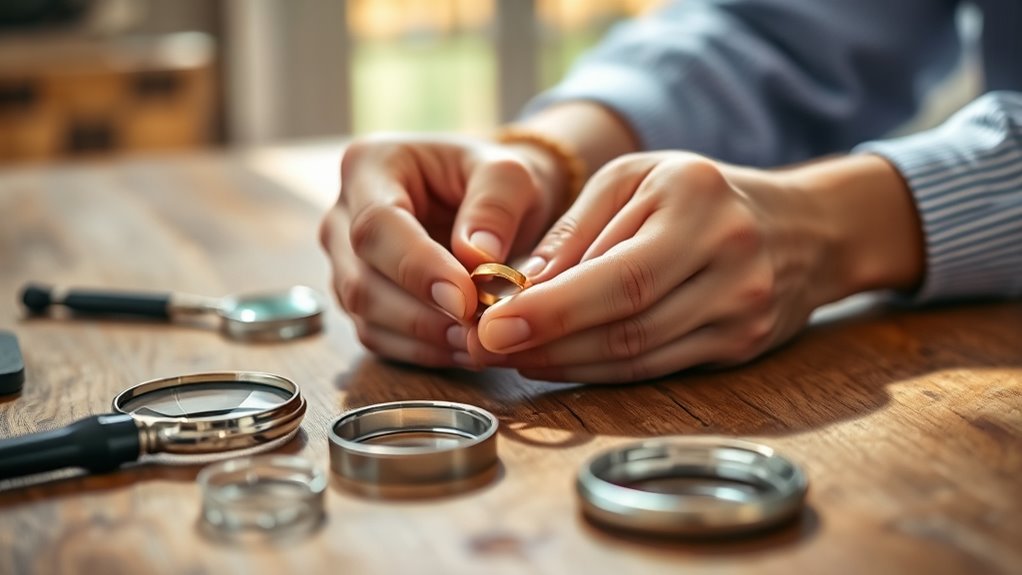
Because these engravings can be tiny or worn, use a magnifying glass or jeweler’s loupe to read them clearly.
The presence and style of these marks help confirm authenticity and even the jewelry’s country of manufacture.
Physical and Visual Inspection Techniques

You can start by feeling the weight of your jewelry—real gold is heavier than most imitations because of its density.
Next, examine the color carefully; genuine gold has a warm, consistent glow that doesn’t fade or tarnish.
If you spot discoloration or dull spots, it’s likely the piece isn’t solid gold.
Weight and Density
A key way to verify if your jewelry is real gold is by evaluating its weight and density.
Solid gold has a high density of about 19.3 g/mL, making it noticeably heavier than brass or gold-plated pieces of similar size.
To check this, use a precise scale to measure your jewelry’s weight in grams.
Then, perform a water displacement test by submerging the piece in a graduated container to find its volume.
Dividing the weight by the displaced water volume gives you the density.
Measurements close to 19.3 g/mL indicate real gold.
If your jewelry feels unusually light or floats, it’s likely hollow or made from a less dense material.
Combining these tests boosts your accuracy in confirming genuine gold.
Color and Tarnish
How can you tell if your jewelry is truly gold just by looking at it?
Genuine gold keeps a consistent, warm color and won’t discolor or tarnish over time. If you notice tarnishing, discoloration, or greenish marks on the jewelry or your skin, it’s likely gold-plated or made from a non-gold alloy.
Over time, plated pieces show wear, especially at edges and high-friction spots, revealing the base metal underneath.
Fake or low-quality metals often develop dullness or dark spots due to oxidation and corrosion.
True gold resists these changes, maintaining its luster despite exposure to moisture, sweat, and air.
Using Household Items for Preliminary Testing

Although professional testing provides the most accurate results, you can quickly assess your jewelry’s authenticity using common household items.
Start with the magnet test: real gold isn’t magnetic, so if your piece is attracted, it’s likely fake or plated.
Next, drag your jewelry across unglazed ceramic; a genuine item leaves a gold streak, while a fake leaves a black or greenish mark.
You can also apply a drop of the acid—like vinegar—to a hidden spot. If you notice discoloration or metal underneath, it’s probably not real gold.
While these methods offer quick clues, they don’t replace professional testing kits designed for precise analysis.
Use these preliminary tests to decide if your jewelry warrants a deeper, more reliable examination.
Performing Density and Water Displacement Tests
When you want to verify your jewelry’s authenticity beyond surface tests, measuring its density through water displacement offers a reliable method.
First, weigh your jewelry in grams using a precise digital scale to ensure accuracy.
Next, fill a graduated cylinder with enough water to fully submerge the piece and record the initial water level.
Gently place the jewelry into the water and note the new level.
The difference between the two levels is the water displacement, which equals the jewelry’s volume in milliliters.
Finally, calculate the density by dividing the weight by the displaced water volume.
Compare this number to gold’s standard density of about 19.3 g/mL.
This test helps you verify if your jewelry is genuine gold or a different material.
Applying Chemical and Acid Testing Methods
Since visual and density tests can only tell you so much, applying chemical and acid testing methods offers a more definitive way to verify your jewelry’s gold purity.
Using an acid test kit, you scratch a small, hidden spot on your piece, then apply nitric acid.
Different acids correspond to different karats, so pick the right one for accurate results.
Watch the reaction carefully—no change means genuine gold, while green or black signals fake gold or lower-quality metal.
Remember to always wear gloves and eye protection during jewelry testing.
For the safest and most accurate results, consider having a professional jeweler perform or interpret the acid test.
- Use the correct acid for your jewelry’s karat
- Apply nitric acid carefully on a discreet scratch
- Look for color changes indicating fake gold
- Prioritize safety with gloves and ventilation
Consulting Professionals for Accurate Verification
When it comes to verifying your jewelry, choosing a qualified appraiser is key to getting accurate results.
Professionals use advanced tools and tests that go beyond what you can do at home, ensuring precise assessments.
Their expertise not only confirms authenticity but also provides detailed reports that add value and peace of mind.
Choosing Qualified Appraisers
Although it might be tempting to rely on quick tests or online tools, consulting a qualified appraiser is essential for accurately verifying your jewelry’s authenticity.
To choose the right expert, focus on their certification and credentials to ascertain they’re reputable.
Don’t hesitate to ask for recommendations from trusted sources to find appraisers with proven experience. Always request a detailed, written appraisal that includes verification of materials and authenticity.
Here’s what to contemplate when choosing an appraiser:
- Certification from recognized organizations like GIA or AGS
- Experience with jewelry and a trustworthy track record
- Written appraisal reports with certification numbers and contact info
- Recommendations from jewelers or collectors you trust
Benefits of Professional Testing
If you want a reliable confirmation of your jewelry’s authenticity, professional testing offers unmatched accuracy.
Certified gemologists use advanced tools like acid testing and electronic analyzers to determine metal composition and verify jewelry authenticity precisely.
This expert approach detects subtle differences that DIY methods often miss, ensuring your piece’s true value is confirmed.
Plus, professional testing provides peace of mind, especially for valuable or vintage items.
| Benefit | Description |
|---|---|
| Accurate Verification | Identifies genuine materials with precision |
| Expert Analysis | Certified gemologists use specialized methods |
| Peace of Mind | Reduces risk of misidentification |
Consulting professionals guarantees you know exactly what you own.
This knowledge protects your investment confidently.
Frequently Asked Questions
How to Test if Jewelry Is Real at Home?
You can test your jewelry at home by using a magnet, applying vinegar, and performing a scratch test on ceramic.
Weighing it for density and inspecting for hallmarks with a magnifying glass are also effective methods.
These steps can help confirm authenticity.
What Does “Gf” Mean on Jewelry?
“GF” means your jewelry is gold filled, which has a thick gold layer bonded to a base metal.
It’s more durable than gold plated but not solid gold.
This makes it a great option for good quality and affordability for everyday wear.
How Can I Check My Jewelry at Home?
You can check your jewelry at home by looking for stamps like “14K” or “925.”
These stamps indicate the metal quality.
You can also test with a magnet to see if it sticks, as some metals are non-magnetic.
Applying vinegar can help spot discoloration, which is a sign of lower quality.
Another method is scratching the jewelry on a piece of unglazed ceramic.
This will show you the streak color, which can indicate the metal type.
Lastly, weigh your jewelry to compare its density with known values for different metals.
Does Real Gold Float or Sink?
Real gold sinks quickly because it’s very dense.
If your jewelry floats or hovers, it’s probably not solid gold or could be hollow.
Keep in mind, this test isn’t foolproof, so do more checks for certainty.
Conclusion
Just like a detective uses clues to solve a mystery, you can uncover the truth behind your jewelry’s authenticity by following these steps.
Remember, even a tiny hallmark or a simple water test can reveal big secrets.
One jeweler once told me, “Real gold doesn’t just shine—it tells a story.”
So, trust your tools and instincts.
But when in doubt, consult a pro to keep your treasures genuine and shining bright.
In conclusion, determining if your jewelry is real can be an exciting adventure.
By using simple tests and being attentive to details, you can uncover the authenticity of your pieces.
Always remember to look for hallmarks, perform water tests, and trust your instincts.
And if you’re ever unsure, seeking professional advice is a wise choice to ensure your treasures remain genuine and dazzling!