How Can You Tell If Jewelry Is Gold?
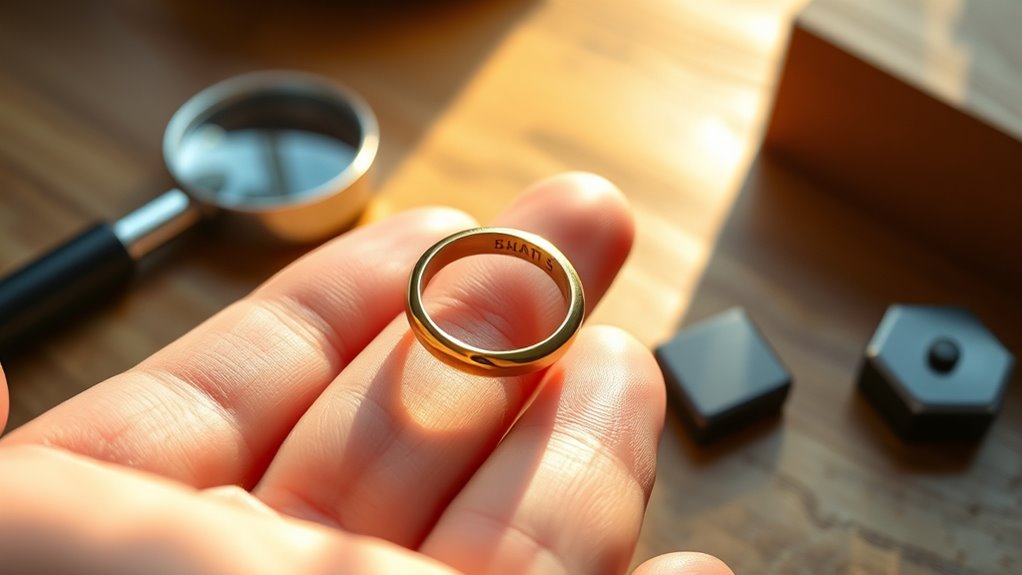
You can tell if your jewelry is gold by checking for hallmarks like “14K” or “750.”
Feeling its weight is also a good indicator—it should feel heavier than other metals.
Look for a consistent warm yellow color and a smooth metallic shine.
Try simple tests like using a magnet (gold isn’t magnetic) or dropping it in water (real gold sinks).
These clues can help, but exploring further can reveal even more reliable ways to confirm authenticity.
Understanding Gold Purity and Hallmarks

Although gold jewelry looks similar on the surface, its purity can vary widely.
Understanding karats and hallmarks helps you identify genuine pieces. Gold purity is measured in karats, with 24K representing nearly 99.9% pure gold, while lower karats like 14K contain more alloy metals.
Karats indicate gold purity; 24K is nearly pure, while lower karats include more alloy metals.
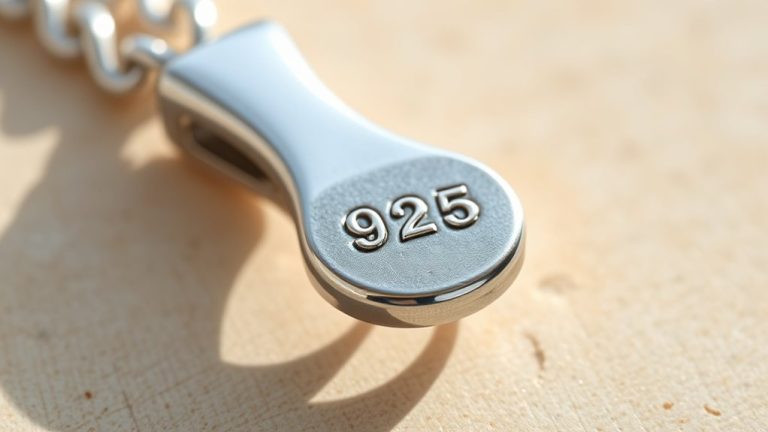
You’ll often find stamps or hallmarks inside jewelry, such as “14K,” “18K,” or “750,” indicating the gold’s purity. These marks come from official assay offices or manufacturers to certify authenticity.
However, don’t rely solely on hallmarks; some counterfeit pieces use misleading stamps.
Knowing regional hallmark standards and verifying markings with professional appraisals or official resources strengthens your confidence in the jewelry’s purity and authenticity.
Visual and Physical Characteristics of Real Gold

When you hold real gold jewelry, you’ll notice it feels heavier than other metals of the same size because of its density.
Its color stands out with a warm, rich yellow hue that stays vibrant over time.
Plus, authentic gold shines smoothly without tarnishing or dulling easily.
Weight and Density
Since gold is much denser than most metals, you can often tell if jewelry is genuine by its weight.
Pure gold has a high density of about 19.3 g/cm³, making it noticeably heavier than other metals of the same size.
When you hold a piece of jewelry, a solid, substantial weight usually indicates a higher gold content.
In contrast, gold-plated jewelry often feels lighter because it’s made from lower-density materials underneath the thin gold layer.
To be sure, you can measure density using the water displacement method—real gold sinks quickly due to its high density.
If the weight or density doesn’t match what you’d expect from pure gold, it’s likely the piece isn’t solid gold but rather a gold-plated or alloyed item.
Color and Shine
The weight and density of gold help you identify its authenticity, but its color and shine offer equally telling clues.
When examining gold jewelry, look for a consistent, warm yellow color that doesn’t fade or change over time. Authentic gold has a uniform color throughout the piece, without any patches or discoloration.
Its shine is rich and lustrous, reflecting light smoothly with a natural metallic glow. This deep shine contrasts sharply with fake or plated metals, which often appear overly shiny, plasticky, or dull.
Pay attention to the metal’s appearance—real gold maintains its brightness without tarnishing.
Using Vinegar to Test Gold Authenticity

If you want a simple and affordable way to check if your jewelry is real gold, vinegar can help. This DIY test is popular for verifying gold because it’s quick and non-damaging to pure gold pieces.
To test gold, place your jewelry on a non-porous surface or in your palm, then pour a small amount of vinegar onto it. Watch for any reaction, as spotting the real deal is all about how the metal responds.
Here’s how vinegar works for spotting the real deal:
- Pure gold shows no color change or dullness after vinegar exposure.
- Gold plated or fake pieces may discolor or lose shine.
- Soaking in vinegar for 5-8 minutes intensifies the acid test.
- Rinse with water afterward to check for lasting changes.
Keep in mind, this method isn’t always reliable for gold-plated items or alloys.
The Magnet Test for Gold Jewelry
You’ve seen how vinegar can reveal whether your jewelry holds up as real gold.
Now, try the magnet test for gold jewelry.
Gold is non-magnetic, so if your piece is attracted to a strong magnet, like a neodymium one, it’s likely fake gold or contains base metals such as iron or nickel.
However, be cautious; some authentic gold jewelry may have magnetic parts in clasps or settings.
To check authenticity accurately, test different areas of the piece.
The magnet test is quick and inexpensive, making it a handy initial method.
Still, it works best combined with other tests to confirm whether your jewelry truly is solid gold or just gold-plated.
This helps you avoid mistaking base metals for genuine gold jewelry.
Performing a Water Float Test
You can test your jewelry by placing it in water to see if it sinks or floats, since real gold is dense enough to sink quickly.
Keep in mind that lighter metals like brass may float, so this test isn’t foolproof on its own.
To get a clearer result, you’ll want to combine it with other methods or check the jewelry’s density more precisely.
How Float Test Works
A simple water float test can quickly indicate whether your jewelry is genuine gold.
This method relies on the principle of buoyancy and density.
When you place the jewelry in water, its behavior reveals its material:
- Genuine gold, with its high density, sinks rapidly to the bottom.
- Fake or lighter metals may float or stay suspended due to lower density.
For accurate results, clean your jewelry to remove dirt or coatings that affect buoyancy.
Use a clear container filled with water to observe the jewelry’s movement clearly.
Real Gold Density
Understanding how real gold behaves in water helps confirm its authenticity through density.
Real gold has a high density of about 19.3 grams per cubic centimeter, which makes it much heavier than most metals used in jewelry.
When you perform the water float test, genuine gold pieces will sink quickly to the bottom of the water due to this density.
To verify the authenticity, weigh your gold piece first, then submerge it and observe.
If it sinks rapidly, it’s a strong sign your gold is real.
In contrast, fake gold or lighter metals tend to float or stay suspended.
The water float test offers a simple, effective way to check gold density and confirm if your gold pieces are authentic.
Limitations of Test
Although the water float test offers a quick way to check gold authenticity, it can be misleading due to factors like hollow designs, gold plating, or irregular shapes that affect buoyancy.
You should be aware of these limitations before relying solely on this method.
For example:
- Hollow or gold-plated jewelry may sink or float unexpectedly, causing false negatives.
- Gold alloys vary in density, affecting whether pieces sink or float accurately.
- Surface coatings or tarnish can make fake gold mimic real gold’s density, skewing results.
- Irregular shapes or low-density solid gold pieces might float, leading to incorrect assumptions.
Because of these factors, the water float test is best used alongside other tests for a reliable assessment of your jewelry’s authenticity.
Lighter Test to Identify Genuine Gold
When you expose gold jewelry to a butane lighter flame, you’ll notice that genuine gold resists burning. It maintains its bright yellow color without producing smoke or darkening.
This lighter test is a simple way to check the authenticity of your gold pieces. Genuine gold won’t burn or blacken because it has a high melting point and doesn’t catch fire easily.
In contrast, counterfeit or plated metals often darken, blacken, or emit smoke when exposed to the flame. While the lighter test can help you spot fake jewelry quickly, you should use caution to avoid damaging the piece.
Scratch and Makeup Testing Methods
If you want a quick way to check your gold jewelry at home, the scratch and makeup tests offer simple, effective options.
These methods help you test the authenticity of your gold piece without special tools.
The scratch test involves rubbing your gold jewelry on an unglazed ceramic tile.
Real gold leaves a gold-colored streak, while fake gold leaves a dark one.
In the makeup test, you rub liquid foundation on the gold piece and let it dry.
Genuine gold won’t smear or lift the makeup.
Both tests are inexpensive and cause minimal damage.
While not as precise as lab tests, they’re excellent first steps to identify real gold jewelry.
Try these tests to quickly assess if your gold jewelry is authentic.
Professional Gold Testing Techniques
How can you be absolutely sure your gold jewelry is genuine?
Professional gold testing techniques offer reliable answers. X-ray fluorescence (XRF) analysis non-destructively reveals the exact metal composition, pinpointing gold purity with high accuracy.
X-ray fluorescence (XRF) analysis accurately identifies gold purity without damaging your jewelry.
You can also use acid testing, where nitric acid applied to a scratch shows the karat level by its reaction.
Electronic gold testers measure electrical conductivity quickly, confirming authenticity without damaging your piece.
Another method, specific gravity testing, compares your jewelry’s density to gold’s standard 19.3 g/cm³ to verify its authenticity.
Professionals also perform hallmark verification during visual inspections to ensure markings match the claimed gold purity.
Combining these techniques gives you a thorough, trustworthy assessment of your gold jewelry’s true value.
Common Misconceptions About Gold Testing
Knowing the professional techniques for testing gold helps you avoid common misconceptions that can lead to costly mistakes.
You might think a piece is genuine if it sinks in water or isn’t magnetic. But these home tests often fail due to hollow or plated jewelry.
Don’t depend solely on visual inspection or a single method.
Also, just because jewelry is stamped with a hallmark doesn’t guarantee authenticity—fake markings are common.
Remember these points:
- Pure gold can still scratch and show wear over time.
- Fake or plated gold may tarnish or lose color.
- A stamped hallmark isn’t always trustworthy.
- Using multiple methods ensures more accurate results.
Trusting multiple methods and professional verification beats relying on myths or quick home tests.
Frequently Asked Questions
How Do You Test Gold at Home?
You can test gold at home by using vinegar to check for color changes.
A magnet can help you see if it sticks.
Rubbing it on ceramic will show you the streak color,
and dropping it in water will let you see if it sinks.
These simple methods can give you a good idea about the authenticity of your gold.
How Can I Check if My Jewelry Is Real Gold?
Like a detective spotting clues,
you check for stamps like 14K.
Test with a magnet—real gold won’t stick.
Try vinegar for color changes.
When in doubt,
trust a jeweler’s expert eye to confirm authenticity.
Will a Magnet Stick to Gold Plated Jewelry?
A magnet might stick to gold-plated jewelry if its base metal is magnetic.
But if it doesn’t, that doesn’t guarantee it’s solid gold.
Some base metals aren’t magnetic, so it’s best to use other tests for better accuracy.
How to Test Gold at Home With Vinegar?
Pour vinegar on your jewelry and watch closely.
If the color or shine changes, it’s probably not pure gold.
If it stays the same, your piece is likely genuine.
Rinse afterward to protect it.
Conclusion
You might think gold’s value lies only in its shine, but true authenticity reveals itself in subtle tests—like vinegar’s sour touch or a magnet’s cold rejection.
While some methods seem simple, others demand expert eyes. This shows how gold’s worth balances between everyday tricks and professional precision.
So, don’t just trust the gleam; test, compare, and question.
Real gold isn’t just seen—it’s proven.
To determine if your jewelry is truly gold, you can conduct a few simple tests. Use vinegar to see if it tarnishes or check with a magnet to see if it sticks. Remember, the best way to ensure authenticity is to consult a professional.
In conclusion, understanding how to tell if jewelry is gold combines practical tests and expert insights. Always be curious and thorough in your approach, because real gold is not just about appearance—it’s about verification.