How Do Jewelry Stores Buy Gold When You Sell It?
When you sell gold to a jewelry store, it’s important to understand how they determine its value. They start by checking the purity of your gold, which involves looking for karat marks.
They often use tests like acid or XRF analysis to get accurate readings.
Next, they weigh your gold precisely and compare this weight to the current market spot price.
Based on this evaluation, they typically offer you a percentage of its melt value, which usually ranges from 40% to 60%.
This percentage can vary depending on market demand and the condition of the jewelry.
By knowing this process, you can better navigate selling your gold and potentially secure a better deal.
Keep exploring to discover how you can sell smartly and get the best value for your gold.
Types of Gold Jewelry and Their Purity

When you sell gold jewelry to a store, its karat rating plays a crucial role in determining its value.
This rating reflects the purity of the gold, with 24K being pure gold and lower karats like 14K indicating a mix with metal alloys.
You’ll often find purity hallmarks stamped on pieces—numbers like 585 or 750—which correspond to 14K and 18K gold, respectively.
These marks help the store quickly identify the gold content.
The higher the karat rating, the more pure gold the jewelry contains, which typically means a higher melting value.
Conversely, items with lower karat ratings, such as 10K or 12K, have more alloys and less pure gold, resulting in a lower resale price.
Understanding these basics helps you grasp how stores assess your gold jewelry’s worth.
Assessing the Weight and Karat of Your Gold

Because both weight and karat purity directly impact your gold’s value, jewelry stores carefully measure these factors to provide a fair offer.
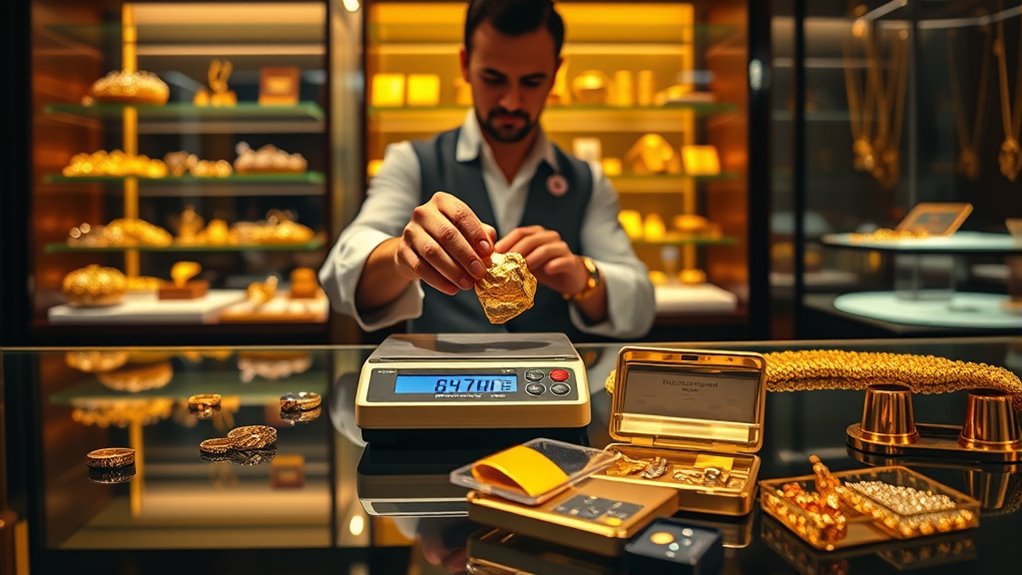
They start with a precise weight assessment using calibrated scales, measuring your gold in grams or troy ounces.
Next, they look for the karat mark stamped on your jewelry, like 14K or 18K, which indicates gold purity.
Since the karat mark alone isn’t always reliable, some stores use acid testing to confirm the gold purity without damaging your piece.
Higher karat means higher gold content, so knowing the exact purity helps determine the true value of your item.
Understanding how stores assess weight and karat ensures you get a transparent, accurate offer when selling your gold.
Tools Jewelry Stores Use to Verify Gold Purity

Although visual marks like hallmarks offer initial clues, jewelry stores rely on specialized tools to verify gold purity accurately.
Hallmarks such as 14K or 585 give a starting point, but purity verification requires more precise methods.
X-ray fluorescence (XRF) analyzers are common, providing a non-destructive, highly accurate reading of gold content.
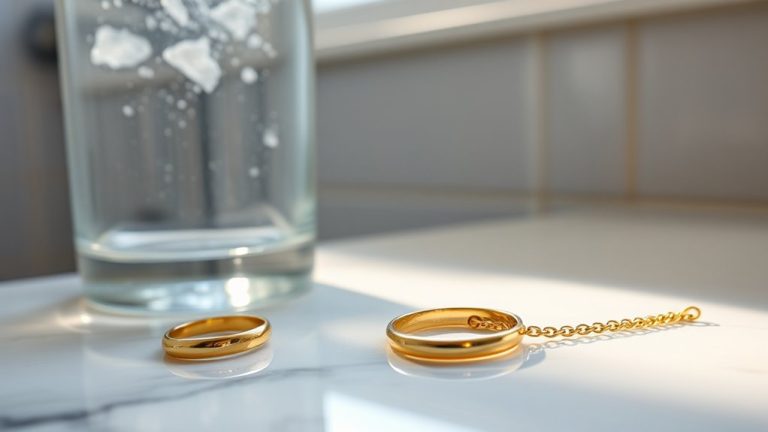
Acid testing comes next, where a small acid drop on a discreet spot reveals karat levels through a color reaction.
Electronic testing devices measure electrical conductivity, correlating with gold purity to deliver quick results.
These tools ensure the store assesses your gold’s true value beyond just the stamped markings.
This way, you get a fair and accurate evaluation when you sell your gold.
How Jewelry Stores Determine the Market Value of Gold
When you bring gold to a jewelry store, they first assess its purity to know exactly what they’re working with.
Then, they weigh your gold accurately to determine how much material you have.
Finally, they apply the current spot price to calculate the market value based on that purity and weight.
Assessing Gold Purity
To accurately assess the market value of gold, jewelry stores carefully determine its purity through several reliable methods.
First, they check hallmarks stamped on the piece indicating its karat weight, such as 14K or 18K.
To get a precise reading of gold purity, they often use X-ray fluorescence (XRF) analyzers, which measure the metal’s composition without harming your item.
Next up are acid tests, where a small drop of acid is applied to a discreet spot to confirm karat levels by observing color changes.
Once purity is verified, stores calculate the melting value by combining the gold’s purity percentage with its weight.
This careful process ensures you get a fair price reflective of your gold’s true market worth.
Calculating Weight Value
Since the value of gold depends heavily on its weight and purity, jewelry stores start by weighing your items on calibrated scales to get an accurate measurement in grams or troy ounces.
They then determine the purity level, often identified by hallmarks like 14K, to calculate the actual gold content.
By multiplying the gold weight by this purity percentage, they find the pure gold weight.
This figure is vital because the store uses it to estimate the melt value, which represents the raw gold’s worth before any markup.
Although the market price influences this calculation, the store’s final offer factors in their buy percentage and calibration of prices to guarantee precision and profitability.
This process guarantees you get a fair, market-based valuation.
Applying Current Spot Price
How do jewelry stores decide what to pay you for your gold?
They start by checking the current market spot price, which changes daily based on financial market activity.
The spot price reflects the real-time value of a troy ounce of pure gold.
When you sell gold, the jewelry store uses this live data from trading platforms and industry tools to set a baseline.
However, they don’t pay the full spot price; offers typically range between 40% to 60% of that value.
The exact amount depends on factors like the purity of your item, its weight, and condition.
Pricing Formulas and Percentages Paid by Jewelry Stores
Although jewelry stores aim to offer fair prices, they typically pay between 40% and 60% of the melt value when buying gold from sellers like you.
They use pricing formulas based on the current gold prices and the item’s weight, applying a standard discount rate to cover refining costs and profit margins.
This percentage of the spot price reflects market fluctuations and store policies.
Some stores offer a fixed percentage, such as 50%, while others negotiate depending on the piece’s resale or scrap value.
Understanding these pricing formulas helps you set realistic expectations when selling your gold.
Keep in mind that the discount rate ensures stores remain profitable while providing you a competitive payout aligned with the melt value of your gold.
The Role of Condition and Design in Valuing Gold Pieces
When you bring gold pieces to a jewelry store, their condition and design play a crucial role in determining their value.
Jewelry stores assess the condition carefully; well-maintained items fetch higher offers, while scratches or dents may lower valuation.
Well-maintained gold jewelry earns higher offers; scratches or dents can reduce its value.
However, minor wear usually has little impact if the overall design remains appealing.
The design itself, especially if complex or featuring gemstones, can boost the price considerably.
Brand-name pieces from designers like Tiffany & Co. or Cartier often command premium offers regardless of condition due to their recognized value.
Ultimately, the jewelry store decides whether to resell, repair, or melt down your gold based on these factors, which directly influences how much you’ll receive.
Understanding this can help you prepare your items for the best possible valuation.
Common Selling Procedures at Jewelry Stores
Since you want to get the best deal, understanding the common selling procedures at jewelry stores is key.
When you bring in your gold, the store first inspects it for authenticity, damage, and hallmarks.
They then perform non-destructive testing, like XRF analysis or acid testing, to determine its purity.
After testing, they weigh your gold on calibrated scales and calculate its melt value based on current market prices and karat.
The store’s offer typically ranges from 40% to 60% of this valuation.
Once they present the offer, you can decide to accept it.
Payment is usually immediate, either in cash, check, or store credit.
This straightforward process guarantees you know exactly how your gold’s market value influences the offer you receive.
Tips for Getting the Best Price When Selling Gold to Jewelers
To get the best price when selling your gold to jewelers, you should start by researching and comparing offers from several stores.
Jewelry stores buy your gold at different rates depending on market conditions, item quality, and demand.
Obtaining multiple offers helps you spot the best price and negotiate confidently.
Clean your gold before visits, and consider professional testing to verify purity and weight, which can boost your leverage.
| Tip | Reason | Benefit |
|---|---|---|
| Research multiple offers | Rates vary by store and market | Secure the best price |
| Clean your gold | Improves appearance | Attracts higher offers |
| Test purity/weight | Provides accurate valuation | Strengthens negotiation |
| Consider item specifics | Designer/vintage items pay more | Maximize value |
| Monitor market conditions | Prices fluctuate | Time sale for better returns |
Frequently Asked Questions
When You Sell Gold to a Jeweler, What Happens?
When you sell gold, the jeweler tests its purity and weight.
They then calculate its melt value based on market prices.
After that, the jeweler offers you a payout.
If your gold has gemstones, they may remove those before either melting the gold or adding it to their inventory.
Is It Better to Sell Your Gold to a Jeweler or a Pawn Shop?
Selling gold to a jeweler is like choosing a fine meal over fast food—you’ll get more value and better offers.
Pawn shops pay less since they prioritize quick cash.
How Do Jewelers Buy Gold?
Jewelers evaluate your gold’s purity and weight, then offer a price based on current market value minus their margin.
They’ll test it, consider condition or brand, and negotiate before buying your gold for resale or melting.
How to Get the Most Money When Selling Gold Jewelry?
To get the most money, clean your gold jewelry.
Know its purity and current market price.
Get multiple offers, and highlight designer brands or excellent condition.
Don’t settle—negotiate confidently for the best deal.
Conclusion
When you sell gold to jewelry stores, it’s important to know a few key things. First, identify the type of gold you have and check its weight.
Next, verify its purity. Understanding how stores determine value is crucial.
Also, consider the condition and design of your gold items. Following their selling procedures carefully will help you navigate the process smoothly.
By staying informed and prepared, you’ll position yourself to negotiate confidently.
Remember, the more you know about your gold, the better deal you can secure. Trusting the process and standing firm in your expectations will always work in your favor.
In conclusion, knowing your gold’s type, weight, and purity is essential for getting the best price when selling to jewelry stores. Be prepared, informed, and assertive during negotiations. This way, you can ensure a fair transaction and maximize your profits.